African Centre for Cities International Urban Conference 2018

University of Cape Town Upper Campus, Cape Town , Western Cape, South Africa

To celebrate the ten-year anniversary of the establishment of the African Centre for Cities, we are hosting the ACC International Urban Conference from 1 to 3 February 2018, at the University of Cape Town.

One Table Two Elephants

Neville Alexander Lecture Theatre 1A Upper Campus, University of Cape Town, Rondebosch, Western Cape, South Africa

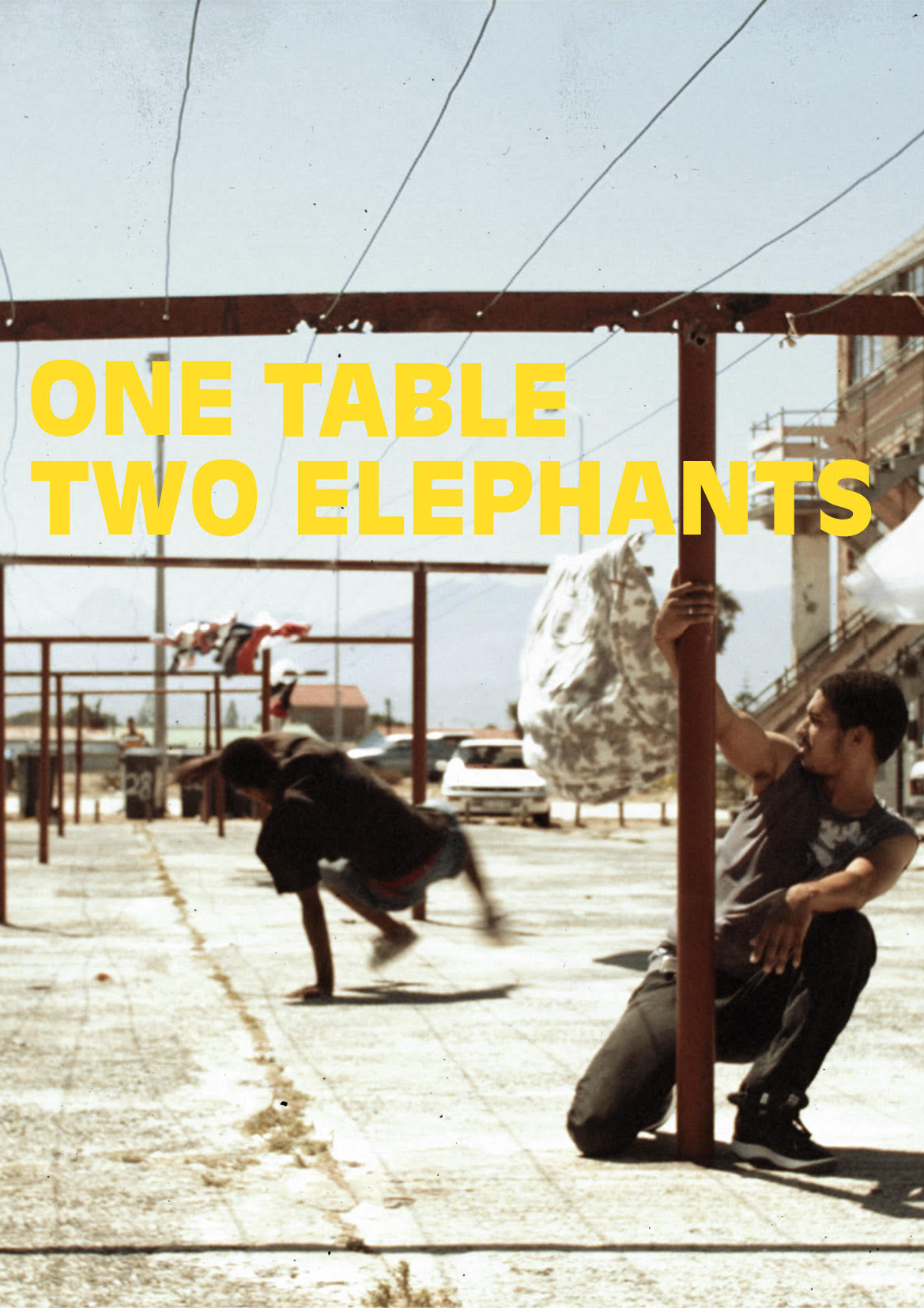
Please join us for the screening of the film ONE TABLE TWO ELEPHANTS (84 minutes, work in progress) at the ACC International Urban Conference 2018 in Cape Town. WHEN: Friday 2 Feb 2018, 13:00-15:00, and Saturday 3 Feb 2018, 13:00-15:00 WHERE: Neville Alexander Lecture Theatre 1A, Upper Campus, UCT (venue lies between the New Lecture Theatre and Leslie Social Science building) The film is based on work in Cape Town by Jacob von Heland and ACC-based researcher Henrik Ernstson. These two screenings have been especially organised for the ACC IUC 2018 delegates and UCT film students. Each screening will be followed by a Q&A with Henrik Ernstson. RSVP not needed. Synopsis ONE TABLE TWO ELEPHANTS is a film about bushmen bboys, a flower kingdom and the ghost of a princess. Entering the city through it's plants and wetlands, the many-layered, painful and liberating history of the city emerges as we see how biologists, hip hoppers, and wetland activists each searches for ways to craft symbols of unity and cohesion. But this is a fraught and difficult task. Perhaps not even desirable. Plants, aliens, memories and ghosts keep troubling efforts of weaving stories about this place called Cape Town. Situated and grounded in lived experiences across a range of groups, this film follows different ways of knowing and tries to be a vehicle toward difficult yet urgently needed conversations about how race, nature and the city are intertwined in our postcolonial world where history is ever present in subtle and direct ways. Based on years of research in Cape Town, this ‘cinematic ethnography’ is directed towards a wider audience, from the general public to students and scholars as it brings texture to understand a city like Cape Town, while providing ample possibilities to translate what is happening “there” to conversations about your own city and surroundings. Created by: Jacob von Heland and Henrik Ernstson. Photography (DOP): Johan von Reybekiel. Sound: Jonathan Chiles. Production coordination: Jessica Rattle and Nceba Mangesi.

ACC BROWNBAG Future Foreshore: are affordable housing and lowered freeways possible?

Studio 5 Environmental and Geographical Sciences Building, Upper Campus, Cape Town, South Africa

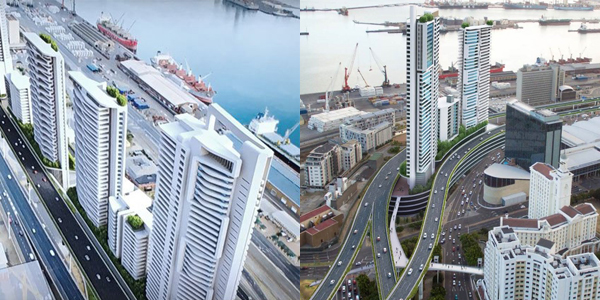
Join ACC on Thursday, 8 March at 13:00 for the first in a series of Brownbag seminars. The hot topic of discussion is the winning bid for the redevelopment of the Foreshore Freeway Precinct, Cape Town. SPEAKERS Lisa Kane Kane is a Honorary Research Associate with the Centre for Transport Studies at UCT and co-founder and board member of Open Streets, Cape Town. Her PhD thesis considered the history and politics of engineering of the Foreshore freeway projects from its initiation to the 1980s, and how that period has informed current thinking around road engineering in South Africa. Rob McGaffin McGaffin is a town planner and land economist.  He has worked as town planner with the City of Cape Town and the Gauteng Department of Economic Development, and in property finance at several financial institutions. He was a Mistra Urban Futures Researcher with the ACC. He lectures in the Department of Construction Economics and Management at the University of Cape Town and is a founding member of the UCT - Nedbank Urban Real Estate Research Unit. CHAIR Vanessa Watson WHEN: Thursday, 8 March 2018 TIME: 13:00 to 14:30 VENUE: Studio 5, Environmental and Geographical Sciences Building, Upper Campus, University of Cape Town

ACC Brown Bag: Taken for a Ride by Matteo Rizzo

Studio 3 Environmental and Geographical Science, Upper Campus, UCT,, Cape Town, South Africa

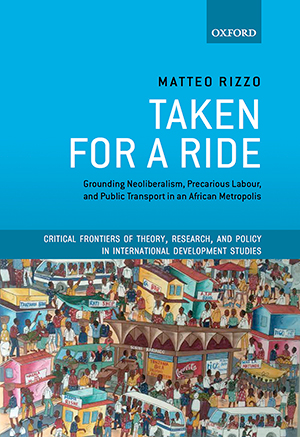
Join ACC on Tuesday, 17 April at 13:00 in Studio 3 in the Environmental and Geographical Sciences Building on Upper Campus for the second talk in a series of Brown-bag seminars. Matteo Rizzo will be discussing themes emerging from his latest book Taken for a Ride: Grounding Neoliberalism, Precarious Labour, and Public Transport in an African Metropolis.  How does public transport work in an African city under neoliberalism? Who has the power to influence its changing shape over time? What does it mean to be a precarious and informal worker in the private minibuses that provide such transport in Dar es Salaam? These are some of the main questions that inform Rizzo's in-depth case study of Dar es Salaam’s public transport system over more than forty years. According to the author Taken for a Ride "is an interdisciplinary political economy of public transport, exposing the limitations of market fundamentalist and postcolonial approaches to the study of economic informality, the urban experience in developing countries, and their failure to locate the agency of the urban poor within their economic and political structures. It is both a contribution to and a call for the contextualized study of neoliberalism." Matteo Rizzo is a Senior Lecturer in Development Studies at SOAS, University of London. Matteo has degrees in Political Sciences from "Orientale"(Naples, Italy)  and Development Studies and History from SOAS (MSc and PhD), where he also completed an ESRC postdoctoral fellowship. Matteo has taught at the LSE, at the African Studies Centre in Oxford and in Cambridge, where he was a Smuts Research Fellow in African Studies at the Centre of African Studies. Matteo is a member of the Editorial Working Group of the Review of African Political Economy and works on public transport for the International Transport Workers Federation. Taken for a Ride will be available for purchase at the Brown-bag session for a special price at only R250. Please bring along cash if you wish to purchase the book.  

Cities and Climate Change: Seminar 1

Studio 1 Environmental and Geographical Sciences Building, Upper Campus, UCT, Cape Town, South Africa

The first seminar in the academic seminar series on Cities and Climate Change reflects on the recent international conference on cities and climate change, the first of its kind convened by the Intergovernmental Panel on Climate Change. Through a panel discussion between representatives from the City of Cape Town, the African Centre for Cities, UCT’s Climate System Analysis Group and the African Climate and Development Initiative, who all participated in the conference, we will draw out key themes and debates surfacing within the climate change and cities field internationally, as well as reflect on any notable silences or gaps. We will also share a snapshot of what inputs we offered to the international science and policy community concerned with cities and climate change. This will establish the main contours of the climate change and cities research space, framing the three subsequent seminars in the series.   SPEAKERS Victor Indasi, climate science post doc, Climate System Analysis Group (CSAG) Amy Davison, Head of Environmental Strategy Implementation, City of Cape Town Alice McClure, FRACTAL coordinator, Climate System Analysis Group Lorena Pasquini, risk governance research fellow, African Climate and Development Institute DISCUSSANT Anna Taylor, urban geography post doc, ACC & CSAG

Academic Seminar Series: Cities and Climate Change

Studio 3 Environmental and Geographical Sciences Building, Upper Campus, UCT, Cape Town , South Africa

Join ACC for 'Cities and Climate Change' a four-part academic seminar series.

Cities and Climate Change: Seminar 2

Studio 3 Environmental and Geographical Sciences Building, Upper Campus, UCT, Cape Town, South Africa

The second seminar in the Cities and Climate Change series will explore low carbon urban energy transitions in (mostly South) African cities, paying particular attention to the institutional dimensions of transforming energy systems to increase energy access and increase sustainability by reducing GHG emissions in growing cities.   In the 20th century, grid electric power radically changed the face of household and community services, industry and commerce. Influence over the electricity grid by powerful human actors also enabled establishment and maintenance of fundamental social and economic structures. However, such influence has not remained uni-directional. The grid, too, has come to influence powerful human actors in ways probably not intended. Hilton Trollip will discuss Hodder’s (2014) use of the ‘entanglement’ concept with reference to analysis of historic and recent developments in South Africa’s energy system.   Saul Roux will discuss research conducted within the Mistra Urban Futures - Knowledge Transfer Programme (MUF-KTP), which involved spending three years in the City of Cape Town, embedded in its Energy and Climate Change Unit, focussing on the conditions under which energy systems transition to more sustainable configurations, through an exploration of the City’s electricity distribution system. Theoretically, the study is situated within debates on socio-technical transitions and the multi-level perspective (MLP) of socio-technical change. Overall, the study explored the implications of applying the multi-level perspective to cities (scale) in the Global South (geographical context) and examines and the role of regulatory and organisational conditions in shaping sustainable transitions.   Anton Cartwright will bring these inputs into conversation with seminar participants around questions of governing low carbon, sustainable and inclusive transitions in African cities.   Hodder, I., 2014. The Entanglements of Humans and Things: A Long-Term View. New Literary History, 45(1), pp.19–36. Available at:http://muse.jhu.edu/content/crossref/journals/new_literary_history/v045/45.1.hodder.html.   Speakers Hilton Trollip, senior researcher in energy policy, Energy Research Centre Saul Roux, legal campaigner, Centre for Environmental Rights (previously ACC Mistra Urban Futures embedded researcher with City of Cape Town)   Chair & discussant Anton Cartwright, institutional economics research fellow, African Centre for Cities WHEN: 15 May 2018 TIME: 15:00 - 16:30 WHERE: Studio 3, Environmental and Geographical Science Building, Upper Campus, UCT


Cities and Climate Change: Seminar 3

Studio 3, Environmental and Geographical Science Building, Upper Campus, UCT, Cape Town, South Africa

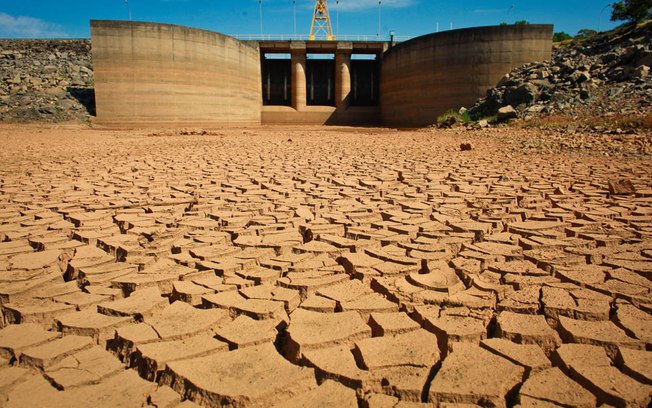
Nate Millington will present a talk entitled Making sense of our water crisis: what can we learn from São Paulo? as part of our on-going series on Cities and Climate Change on 28 May 2018, at 15:00 to 16:30 in Studio 3, Environmental and Geographical Science Building, Upper Campus, UCT. Both Cape Town and São Paulo have recently been marked by drought-induced water crises, as pre-existing infrastructures were forced to confront changing climates, continued growth, and infrastructural breakdown. These dynamics coexist in intimate ways with long histories of auto-construction, heterogeneous infrastructural development, and uneven water security. While water insecurity has long marked cities in the global south, multi-year droughts have resulted in water crises in southern cities with previously robust water management systems. Experiences of citywide scarcity in these two cities point to the increasing regularity and visibility of persistent water crisis at the global level, which is drawing new actors into new coalitions and reconfiguring existing governance patterns. The intensity of the droughts that affected São Paulo in 2013-2015 and Cape Town in 2015-17 are undoubtedly outliers, but when situated in multi-year frameworks the trends seem to suggest that water patterns in both cities are shifting in line with expanded water use and increased urbanization. This has implications not just for São Paulo and Cape Town, but also for southern cities where water insecurity is more chronic. In this seminar, we think comparatively about São Paulo’s experience of crisis and its implication both for Cape Town as well for cities more generally. We ask how São Paulo’s experience with scarcity helps us to think through and make sense of Cape Town’s ongoing crisis. At the same time, we are interested in thinking comparatively about the differences in how the two cities responded. Ultimately, our intention is to think both globally and locally: to put two these two cities in conversation while being clear that global climate change is a planetary phenomenon.   Speaker: Nate Millington Discussant: Anna Taylor Chair: Gina Ziervogel   WHEN: 28 May 2018 TIME: 15:00 to 16:30 VENUE: Studio 3, Environmental and Geographical Science Building, Upper Campus, Cape Town

My Just City is Black and White: Race, Space and Design

Nelson Mandela Foundation 107 Central Street, Houghton, Johannesburg, South Africa

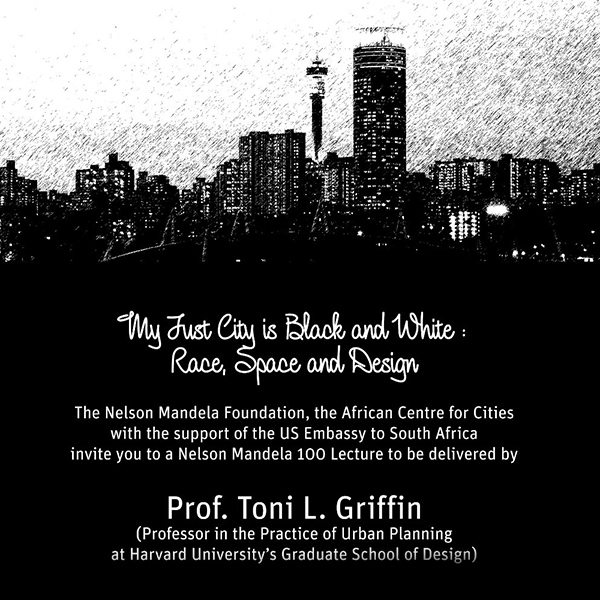
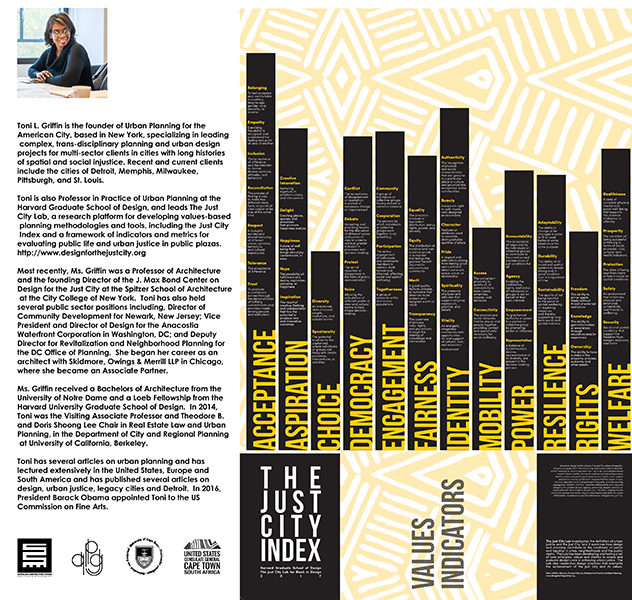
The Nelson Mandela Foundation along with African Centre for Cities and the US Embassy in South Africa are hosting a Nelson Mandela 100 Lecture to be delivered by Prof Toni L. Griffin entitled My Just City is Black and White: Race, Space and Design.

Towards the Just City: Race, Space and Design

Join African Centre for Cities and the School of Architecture, Planning and Geomatics for a lunch time seminar by Prof Toni L. Griffin on 6 June 2018, from 13:00-14:00 in Room 3.33, Centlivres Building, Upper Campus, University of Cape Town. Griffin is the founder of Urban Planning for the American City, based in New York, specialising in leading complex, trans-disciplinary planning and urban design projects for multi-sector clients in cities with long histories of spatial and social injustice. Recent and current clients include the cities of Detroit, Memphis, Milwaukee, Pittsburgh, and St. Louis. She is also Professor in Practice of Urban Planning at the Harvard Graduate School of Design, and leads The Just City Lab, a research programme for developing values-based planning methodologies and tools, including the Just City Index - a framework of indicators and metrics for evaluating public life and urban justice in public spaces.