GPIA Presents Edgar Pieterse on Africa’s Urban Revolution
The Auditorium; Alvin Johnson/J.M. Kaplan Hall 66 West 12th Street (formerly known as Tishman), New York, NY, United Statesat , Alvin Johnson/J.M. Kaplan Hall



at , Alvin Johnson/J.M. Kaplan Hall
The third SA Cities conference takes place at Wits University in Johannesburg. This conference brings together emerging and established South African urban scholars. It is a joint project of CUBES & ACC. Details to follow.
The presentation first addresses the policy and governance contexts for the scalability of community-led slum upgrading based on the Shack/Slum Dweller International methodology. The methodology is based on that of the Indian Alliance (NSDF, Mahila Milan, SPARC), which comprises community-based organizations and NGOs, in partnership with government, delivering municipal services, securing tenure and promoting slum upgrading. The presentation continues with the role of the Pune and Mumbai community-led toilet block precedents in South-South knowledge exchange. About the speaker Richard Tomlinson is Chair in Urban Planning in the Faculty of Architecture Building and Planning at the University of Melbourne. Before going to Australia he served as an urban policy consultant in Southern Africa and as an academic in South Africa and the USA. His clients included the post-apartheid South African government, and provincial and local governments, The World Bank, USAID, UN Habitat international and local NGOs, and also the private sector. As an academic he has served as a Visiting Professor at the University of the Witwatersrand and Columbia University, as a Visiting Scholar and SPURS Fellow at MIT, and a Guest Scholar at the Brookings Institution. His most recent publications, research and teaching concern the effects of Google and social media on urban policy knowledge products; urban policy processes and ‘international best practice’; slum upgrading; the BRICS and the urban legacy of sports mega events; and housing and the Australian city. His most recent book is an edited publication on Australia’s Unintended Cities: The Impact of Housing on Urban Development.
ACC will have a strong presence at the World Urban Forum, and will be participating in a number of events. The World Urban Forum takes place in Medellin, Colombia between 7-11 April 2014
As part of the Future Forshore Project, Anton Cartwright (ACC – UCT) and Darryl Colenbrander (CoCT) will be discussing the issue of sea level rise in Cape Town.
Towards Accessible Urban Areas for Persons with Disabilities: Over 600 million people, approximately 10% of the world’s population, have some type of a disability. In developing countries, due to the two fold correlation between disability and poverty, up to 20% of the population has a disability. Due to structural, environmental and attitudinal barriers they continue to face, persons with disabilities are often prevented from fully participating in the economic and social life, leading to their further impoverishment. Amidst a wide array of tools used to enable the full participation in the society of persons with disabilities, accessibility and universal design are of significant importance when it comes to urban planning. This presentation focuses on transport and infrastructure within the urban setting, and aims to further the understanding of the mobility and access issues experienced by persons with disabilities in developing countries, and to identify specific steps that can be taken to start addressing problems. About the speaker Maša Anišić is a doctoral candidate at the Scuola Superiore Sant’Anna in Italy. Her doctoral thesis examines the UN Convention on the Rights of Persons with Disabilities and the impact of its innovative architecture on the stronger social, economic and cultural rights fulfillment for persons with disabilities.
In her paper “Politics, informality and clientelism - exploring a pro-poor urban politics” Diana Mitlin explores what we have learnt about how to instigate, negotiate or otherwise secure pro-poor government in towns and cities of the global South. With competition for scarce resources, the processes of urban development and specifically the acquisition of land and basic services are intensely political. While the nature of urban poverty differs, there is a consistent set of needs related to residency in informal settlements; tenure is insecure and there is a lack of access to basic services, infrastructure, and sometimes other entitlements. Households and communities have to negotiate these collective consumption goods in a context in which political relations are primarily informal with negotiations that take place away from the transparent and accountable systems of ‘modern’ government. Clientelist bargaining prevails. Much of the existing literature is polarised either critiquing clientelism for its consequences, or arguing that it has been dismissed without any grounded assessment of what might take its place and any considered analysis of what it has managed to deliver. About the Speaker: Diana Mitlin is principle researcher in the Human Settlements Group of the International Institute for Environment and Development. Her areas of research interest and expertise include urban poverty, poverty reduction, community development and civil society. Her current work focuses on collaboration with grassroots organization and support agencies to improve urban neighbourhoods (land tenure, basic services and housing). Before starting with IIED she worked as an economist for the UK Government and has also taught at the Institute for Development Policy and Management at the University of Manchester. Advance Reading: ESID working paper_Mitlin
The Density Syndicate officially kicks off with its first studio on 12 May 2014 at Guga S’Thebe Arts and Culture Centre in Langa. Multi-disciplinary teams, consisting of Dutch and South African urbanists, researchers, and activists will collaborate to develop speculative designs that improve density, and accommodate social mix in a sustainable way. Participants include representatives from: African Centre for Cities (SA); Arup (SA); Cape Town Partnership (SA); City of Cape Town Spatial Planning & Urban Design (SA); Community Organisation Resource Centre (SA); dhk urban (SA); Doepel Strijkers (NL); Dutch Consulate (NL-SA); H+N+S Landscape Architects (NL); International New Town Institute (NL); Jakupa (SA); Land+Civilsation Compositions (NL); Provincial Department of Human Settlements (SA); Sustainability Institute (SA); Urban Water Management Research Unit (SA); Violence Prevention through Urban Upgrading (SA); Witteveen+Bos (NL). Follow us on the ACC website; Facebook and Twitter @ through #DensitySyndicate or #WDC234
Remaking the Edges: Sub-Saharan Africa's New Suburbs — This paper examines the edge areas of Lusaka, based on fieldwork from 2013, as a broad example of the trajectory of urban expansion at the new urban frontiers in Sub-Saharan Africa. I emphasize four themes: (1) the significance of new foreign investment in urban frontier zones (particularly from China); (2) the bifurcated character of the expansion; (3) the rise of surveillance technologies; and (4) the endurance of continuities with European colonialism. About the Speaker: Garth Myers is the Paul E. Raether Distinguished Professor of Urban International Studies at Trinity College. He is Director of the Urban Studies Program. A geographer with thirty years of research experience on and in African cities, Myers teaches courses in both urban studies and international studies at Trinity. Myers has contributed to the growth of urban studies and geography research on the continent, through 5 books and more than 60 articles and book chapters. His most recent book is African Cities: Alternative Visions of Urban Theory and Practice (London: Zed Books, 2011).
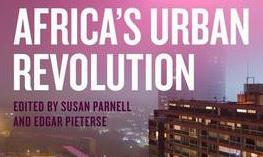
UCT and The Book Lounge will be hosting the launch of Africa's Urban Revolution, the new volume edited by Susan Parnell and Edgar Pieterse