POWER TALKS

Ramolao Makhene Theatre at The Market Theatre Laboratory 138 Lilian Ngoyi Street Newtown, Johannesburg, South Africa

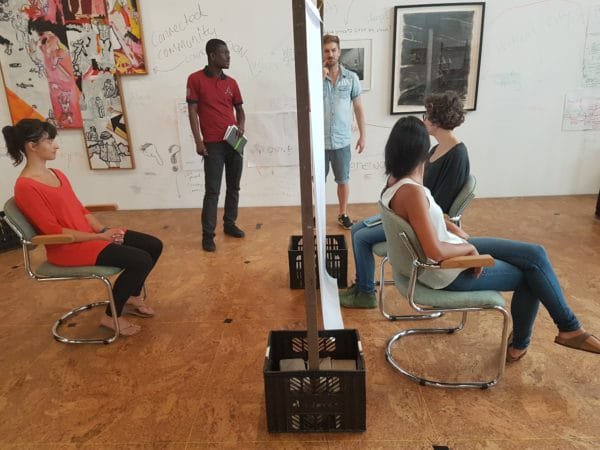
The POWER TALKS discussion series, curated and co-hosted by African Centre for Cities and the Goethe-Institut, considers the various practices of European cultural institutions that are active on the African continent. Working in post-apartheid or post-colonial contexts means, for these institutions, a need to situate themselves carefully as well as to be mindful of, and willing to review their working methods. For the first iteration of POWER TALKS, happening at the Ramolao Makhene Theatre at The Market Theatre Laboratory, we have invited Laila Soliman, Khwezi Gule, Leigh-Ann Naidoo and Molemo Moiloa. The discussion will be facilitated by Jeff Tshabalala. WHEN: Tuesday, 7 May 2019 TIME: 18:30 VENUE: Ramolao Makhene Theatre at The Market Theatre Laboratory, 138 Lilian Ngoyi Street Newtown, Johannesburg POWER TALKS is part of a series of events in 2019 and 2020 to consider dynamics on the African continent and working methodologies of the Goethe-Institut in the region.

GDI Lecture Series: Ambitious and ambiguous public investments in African cities with Edgar Pieterse

The Global Development Institute is pleased to host Edgar Pieterse as part of the GDI Lecture Series, talking about: Ambitious and ambiguous public investments in African cities Urban governance in most African cities is marked by weak regulatory enablement by national governments, limited autonomous fiscal resources, limited managerial capacity, overlaid by distortionary politics—read a combination of clientelism, patronage, corruption, etcetera. At least, this is the conclusion one arrives at by reading most of the academic literature on the topic. However, in contradistinction, over the last decade or so, there has been a proliferation of ambitious planning and delivery, of especially, mega infrastructural projects. These developments coincide with the proliferation of mainstream incantations of “Africa rising” and other boosterism discourses. It raises important questions about how this level of institutional efficacy could be possible if the literature is accurate. In this talk I aim to report on the findings of a research project on so-called turn-around African cities. We set out to document how noteworthy urban mega projects came onto the agenda, were implemented, often effectively, and what the possible effects might be. The idea is to offer a set of empirical reflections, drawing on six African cities, to get a more refined understanding of contemporary urban planning and governance dynamics in rapidly changing and conflictual contexts. The Global Development Lecture Series brings experts involved in global development to The University of Manchester. It aims to facilitate dialogue and discussion, providing a space for leading development thinkers to share their latest research and ideas. Lectures are followed by an audience Q&A. This event is open to members of the public and information on the accessibility of the venue is detailed at this link: https://www.accessable.co.uk/venues/roscoe_th-b

How data-ready are African governments to monitor SDG progress?

Davies Reading Room Room 2.27, Environmental and Geographical Science, UCT, Cape Town, Western Cape, South Africa

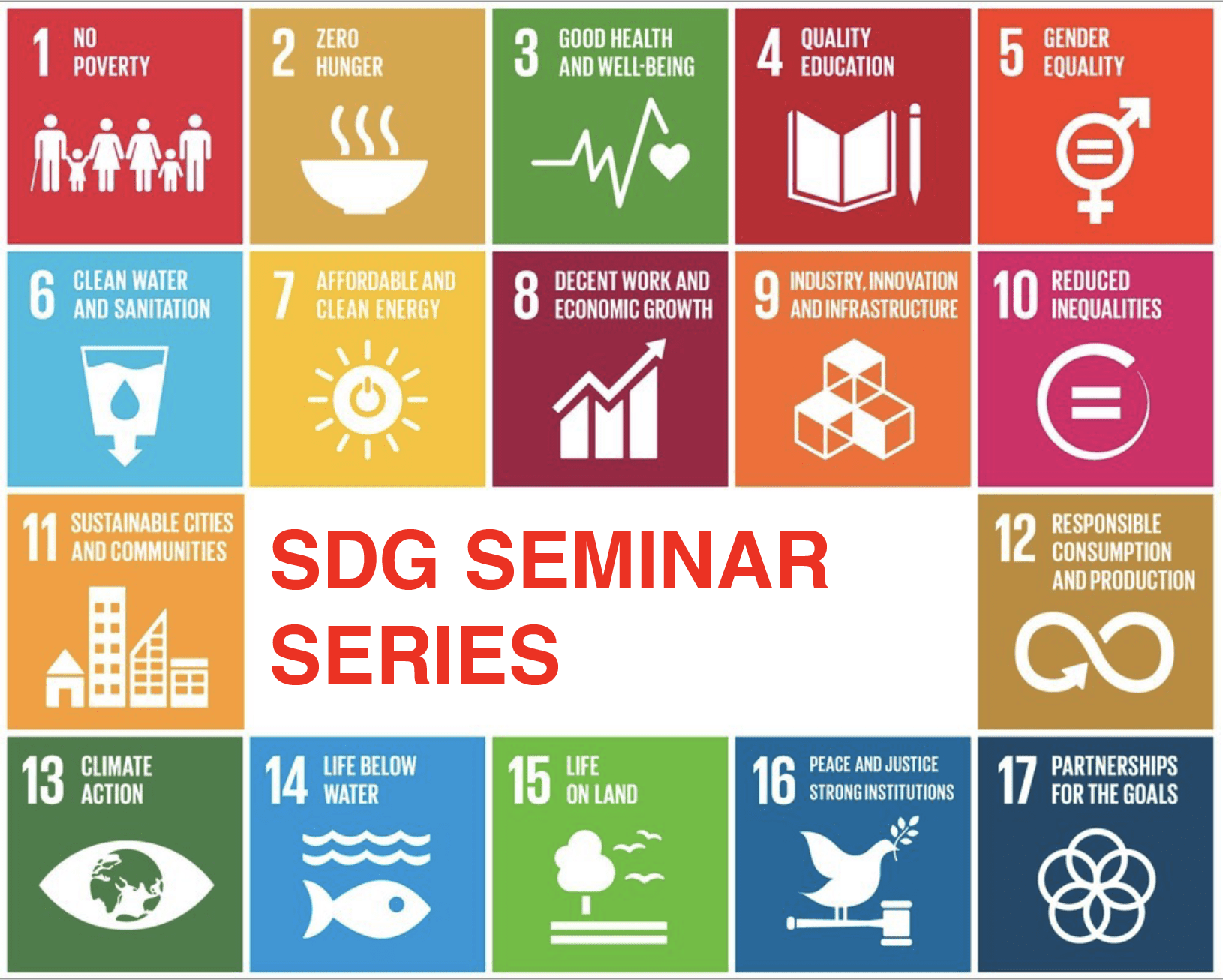
UCT Datafirst Manager Lynn Woolfrey presents How data-ready are African governments to monitor SDG progress? Zambia and Zimbabwe reviews on Wednesday, 15 May at 12:30 to 14:00 in Davies Library, Environmental and Geographical Science Building, Upper Campus, UCT. ABSTRACT It is clear from the development literature that Sustainable Development Goal (SDG) plans must include the building of efficient development data ecosystems (OECD, 2015, p. 16). Such systems can provide governments with country-level indicators for SDG planning and monitoring. For example, the UN Economic Commission for Africa’s Africa Data Consensus suggests that official and other data producers partner to create an international data ecosystem for development planning (UNECA, 2015, p. 2).  In 2017 the UN Development Programme (UNDP) adopted such an ecosystems approach to conduct data audits with African governments. The audits assess a government’s “SDG indicator readiness”- whether accurate and current data is available to compile their SDG indicators – and investigate causes and solutions. The UNDP has found ecosystems mapping useful to expose the causes of poor quality national statistics, such as inadequate funding and bureaucratic resistance to change (Menon, 2017, pp. 12-13, 20). This seminar presents the findings of two SDG indicator readiness audits, in Zambia and Zimbabwe, and comment on the outcomes, and the value and shortcomings of these audits for development data capacity-building in African countries. WHEN: Wednesday, 15 May 2019 TIME: 12:30 to 14:00 VENUE: Davies Library, Level 2, Environmental and Geographical Science Building, Upper Campus, UCT.

From platform to plotform: Artistic thinking in spaces of flux

Seminar Room 2, Centre for Humanities Research, University of the Western Cape

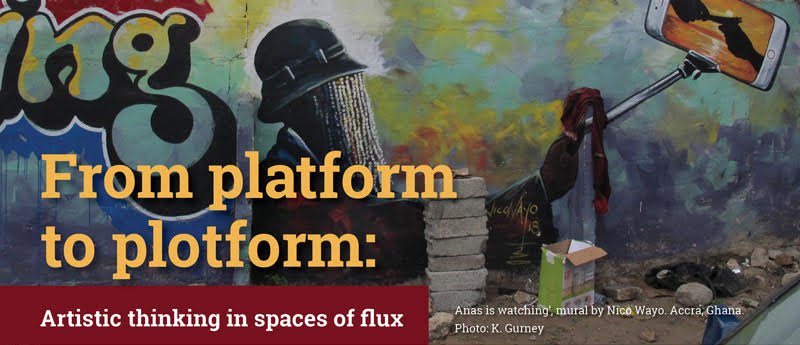
From platform to plotform: Artistic thinking in spaces of flux is a public talk in which ACC research associate Kim Gurney shares work in progress on her project called Platform/ Plotform to help forward future work and interdisciplinary outputs. The project explores working principles identified in participant independent art spaces in five African cities (Nairobi, Accra, Cairo, Addis Ababa and Dar es Salaam), and how the predominant forms and strategies of these selected spaces correspond to the urban fabric. The session, a joint effort between ACC and Centre for Humanities Research, will provide an overview of recently concluded fieldwork and some preliminary findings before opening up for discussion. WHEN: Tuesday, 28 May 2019 VENUE Seminar Room 2, Centre for Humanities Research, University of the Western Cape TIME: 14:00 to 15:00 RSVP: Please RSVP Micaela Felix at centreforhumanitiesresearch@uwc.ac.za

Hacking the Future – New ideas for an urban era

The Old Granary Cnr of Longmarket Street and Harrington Street, Cape Town , South Africa

ACC and Cityscapes Collective presents experts from the worlds of architecture, public health, education, culture and technology to discuss the key ideas driving their work in a series of provocations moderated by award-winning filmmaker, community organiser and urbanist Michael Uwemedimo of CMAP.

SDG Seminar Series: Financing the SDGs in African cities?

Davies Reading Room Room 2.27, Environmental and Geographical Science, UCT, Cape Town, Western Cape, South Africa

The fourth instalment of the ACC SDG Seminar is presented by Liza Rose Cirolia on Wednesday, 19 June 2019 at 12:30 to 14:00 in the Davies Room, Environmental and Geographical Sciences Building, Upper Campus, UCT. Entitled Financing the SDGs in African cities?, her seminar will explore the fiscal constraints and opportunities for local government to participation in global agendas. WHEN: Wednesday, 19 June 2019 TIME: 12:30 to 14:00 VENUE: Davies Room, Environmental and Geographical Sciences Building, Upper Campus, UCT.

Governing Cape Town’s Informal Economy

Studio 5 Environmental and Geographical Sciences Building, Upper Campus, Cape Town, South Africa

ACC invites you to a special Brownbag lecture by Dr Graeme Young entitled Governing Cape Town Informal Economy, on Friday 26 July at 13:00 to 14:00 in Studio 5, EGS Building, Upper Campus, UCT. Young, a visiting QES Scholar, has been working with the Office of the Premier of the Western Cape as part of the wider provincial food system strategy. This presentation will outline initial perspectives on research carried out to understand the institutional and policy landscape in which Cape Town’s informal economy is governed and offer theoretical insights that may be useful for engaging with broader questions surrounding urban governance in Cape Town and beyond. VENUE: Studio 5, Environmental and Geographical Science Building, Upper Campus, UCT DATE: Friday, 26 July 2019 TIME: 13h00 – 14h00

MPhil ‘pumflets’ exhibition

Wolff Architects 136 Buitenkant Street, Bo Kaap, Cape Town, Cape Town , South Africa

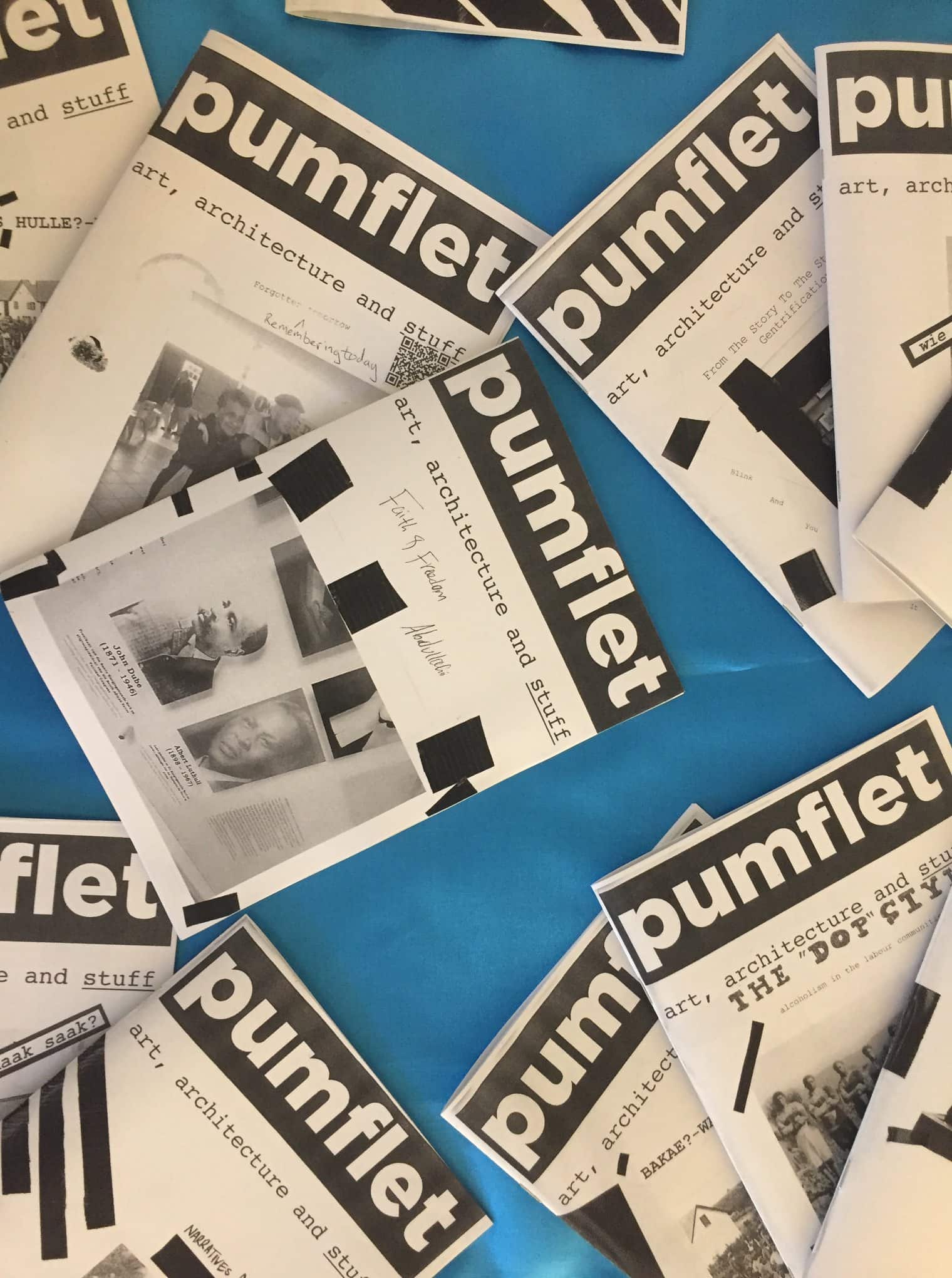
You are invited to attend the one-night only exhibition of pumflets produced by the students of the MPhil Southern Urbanism. The exhibition is the product of the third iteration of the City Research Studio, which forms the cornerstone of the MPhil Southern Urbanism curriculum. The City Research Studio functions as a laboratory space where students learn to walk, see, smell, touch, embrace, explore and reimagine the city through intimate engagements. City Research Studio 3 was convened by Ilze Wolff of Wolff Architects, who co-founded pumflet: art, architecture and stuff with artist Kemang Wa Lehulere in 2016. According to Wolff the publication series explores the social imagination, stories of neighbourhoods and reflecting on histories of the present. "pumflet’s aim is to publicise research-in-process and to conceive of interventions in space and public culture based on research. It is a collection of conceptual art interventions and a collection of correspondence art practices. pumflet, then, is in a way a continued digging and reflecting on the imagination of the collective, with ideas around restoring some ‘deleted scenes’, consequences of forced removals, hyper capitalist urban development and the impacts of state power of the land and the landless," she explains. Using this methodology students have produced their own pumflets over the course of six weeks and will showcase them on Friday, 23 August 2019, from 18:00 at the studio of Wolff Architect, 136 Buitenkant Street, Bo Kaap, Cape Town. WHEN: Friday, 23 August 2019 TIME: 18:00 WHERE: Wolff Architects, 136 Buitengracht Street, Bo Kaap, Cape Town Refreshments will be served.

Stitching fragments and fractals

Pink Room, Centlivres Building Upper Campus, University of Cape Town, Cape Town, South Africa

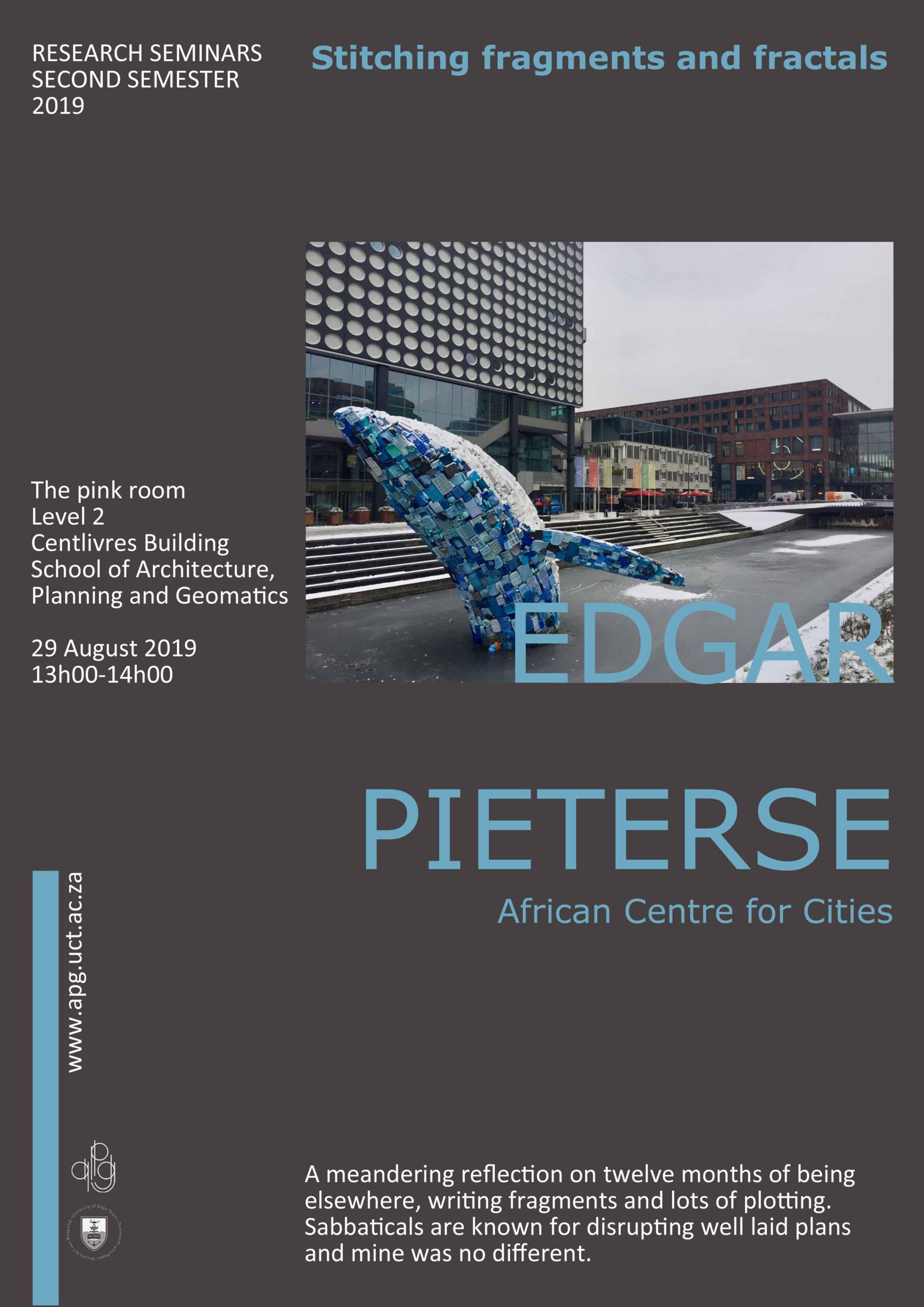
On 29 August 2019, the UCT School of Architecture, Planning and Geomatics is hosting Prof Edgar Pieterse, director of the African Centre for Cities. Pieterse recently returned from a year-long sabbatical and will be reflecting on this in his presentation Stitching fragments and fractals: A meandering reflection on twelve months of being elsewhere, writing fragments and lots of plotting. Sabbaticals are known for disrupting well laid plans and mine was no different. WHEN: 29 August 2019 TIME: 13:00 to 14:00 VENUE: The Pink Room, Level 2, Centlivres Building, Upper Campus, UCT

International Transdisciplinarity Conference 2019

Unnamed Venue Gothenburg, Sweden

The International Transdisciplinary Conference 2019, co-organised by the University of Gothenburg and Mistra Urban Futures, takes place 10 to 13 September 2019 in Gothenburg, Sweden. Our societies are facing critical points in their development, where large challenges are becoming increasingly difficult to handle. Numerous conflicts and complexities are surfacing – to which we can see societies responding with fragmentation, intolerance and exclusion. One way to address such developments is through societal transformation processes that implicitly include a variety of interest groups, stakeholders and organisations. Transdisciplinary research is one approach that focuses specifically on co-producing and integrating knowledge and expertise from a variety of sources, including communities, research, cities and businesses. It is an approach that is driven by the need to create processes where values and transformations towards a more just and sustainable society are openly debated. The aim of this conference, Joining Forces for Change, is to bring together actors from different professional mandates, disciplines and sectors to engage and discuss practical examples and case studies that approach societal transformation through boundary breaking collaboration. The conference invites practitioners and researchers from government and administrative organisations and agencies, interest groups from community and business, and researchers and students from across the university. The overall focus is on what we can learn from our collaborative experiences, case studies and practices regarding wider societal transformation, methodological innovations and theoretical development. We will specifically search for “sites for change” in terms of spaces, practices and learnings where TD research and co-production play a crucial role. The conference programme will be structure around three streams: Societal transformation What experiences in initiating and fostering transformation processes do we have and what can we learn from them? How can different theories of change contribute to sustainable transformations? What forms of organising are needed for our institutions, agencies, companies and universities to handle the necessary transformations, with particular reference to collaboration between different types of stakeholders? What skills and competences are needed by civil servants, researchers and students to co-design and lead processes that target sustainable outcomes? Methodological innovation What does individual and organisational learning in change processes – working on, challenging and transgressing borders – look like? How can universities promote collaborative learning? How can different types of transdisciplinary pedagogies, research methods and processes of co-production be developed to more effectively contribute to societal transformations? Theoretical development How can we imagine and conceptualise a sustainable and inclusive knowledge economy? What are the core challenges in transdisciplinary research regarding ontological and epistemological issues – what worldviews and paradigms are challenged and what kind of knowledge is included and produced? How does TD research engage with systems thinking, scenario planning, design thinking and other holistic theories and practices? Call for contributions Contributions from all fields and research cultures are invited, particularly submissions from practitioners and from transdisciplinary teams. Important dates: Deadline for abstract submission: extended to 31 March 2019 Notice of acceptance: mid-May 2019 For more information go to the conference website.