Academic Seminar Series: Cities and Climate Change
Join ACC for 'Cities and Climate Change' a four-part academic seminar series.



Join ACC for 'Cities and Climate Change' a four-part academic seminar series.
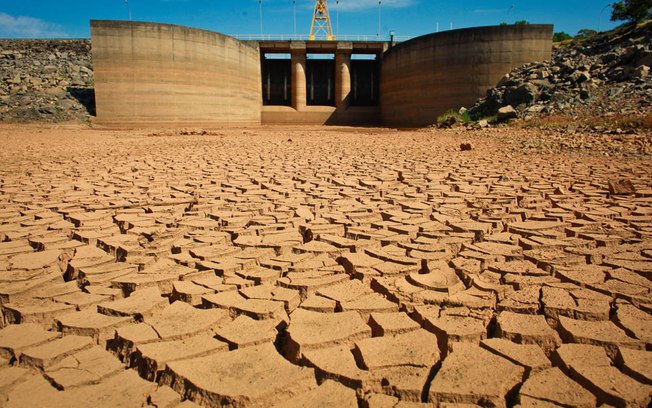
Nate Millington will present a talk entitled Making sense of our water crisis: what can we learn from São Paulo? as part of our on-going series on Cities and Climate Change on 28 May 2018, at 15:00 to 16:30 in Studio 3, Environmental and Geographical Science Building, Upper Campus, UCT. Both Cape Town and São Paulo have recently been marked by drought-induced water crises, as pre-existing infrastructures were forced to confront changing climates, continued growth, and infrastructural breakdown. These dynamics coexist in intimate ways with long histories of auto-construction, heterogeneous infrastructural development, and uneven water security. While water insecurity has long marked cities in the global south, multi-year droughts have resulted in water crises in southern cities with previously robust water management systems. Experiences of citywide scarcity in these two cities point to the increasing regularity and visibility of persistent water crisis at the global level, which is drawing new actors into new coalitions and reconfiguring existing governance patterns. The intensity of the droughts that affected São Paulo in 2013-2015 and Cape Town in 2015-17 are undoubtedly outliers, but when situated in multi-year frameworks the trends seem to suggest that water patterns in both cities are shifting in line with expanded water use and increased urbanization. This has implications not just for São Paulo and Cape Town, but also for southern cities where water insecurity is more chronic. In this seminar, we think comparatively about São Paulo’s experience of crisis and its implication both for Cape Town as well for cities more generally. We ask how São Paulo’s experience with scarcity helps us to think through and make sense of Cape Town’s ongoing crisis. At the same time, we are interested in thinking comparatively about the differences in how the two cities responded. Ultimately, our intention is to think both globally and locally: to put two these two cities in conversation while being clear that global climate change is a planetary phenomenon. Speaker: Nate Millington Discussant: Anna Taylor Chair: Gina Ziervogel WHEN: 28 May 2018 TIME: 15:00 to 16:30 VENUE: Studio 3, Environmental and Geographical Science Building, Upper Campus, Cape Town
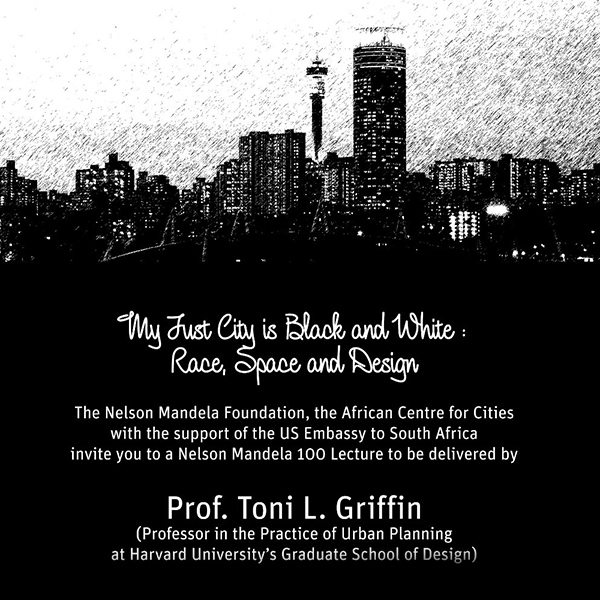
The Nelson Mandela Foundation along with African Centre for Cities and the US Embassy in South Africa are hosting a Nelson Mandela 100 Lecture to be delivered by Prof Toni L. Griffin entitled My Just City is Black and White: Race, Space and Design.
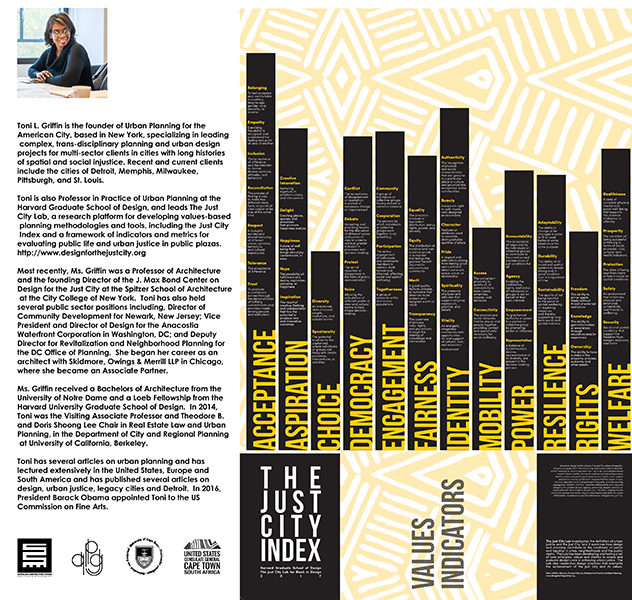
Join African Centre for Cities and the School of Architecture, Planning and Geomatics for a lunch time seminar by Prof Toni L. Griffin on 6 June 2018, from 13:00-14:00 in Room 3.33, Centlivres Building, Upper Campus, University of Cape Town. Griffin is the founder of Urban Planning for the American City, based in New York, specialising in leading complex, trans-disciplinary planning and urban design projects for multi-sector clients in cities with long histories of spatial and social injustice. Recent and current clients include the cities of Detroit, Memphis, Milwaukee, Pittsburgh, and St. Louis. She is also Professor in Practice of Urban Planning at the Harvard Graduate School of Design, and leads The Just City Lab, a research programme for developing values-based planning methodologies and tools, including the Just City Index - a framework of indicators and metrics for evaluating public life and urban justice in public spaces.
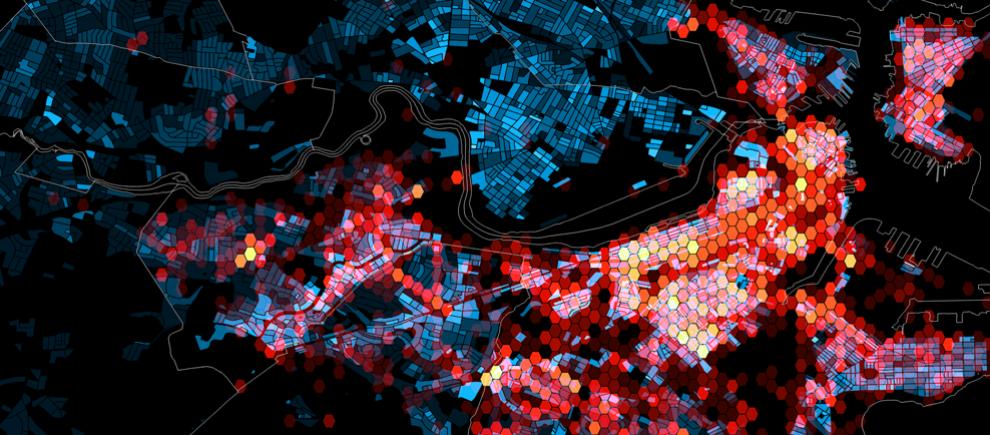
African Centre for Cities, along with Prodig, French National Centre for Scientific Research, French Institute of South Africa and the French Institute for Research in Africa, are presenting a one-day workshop entitled Cities, geo-technologies and data-driven urbanism. The programme is structured into four sessions with two sessions of strategic input from research and practice by various presenters (see below) and two work sessions to discuss and synthesize the inputs. WHEN: Monday, 11 June 2018 TIME: 08:30 to 16:45 WHERE: Room 3B, RW James Building, Upper Campus, University of Cape Town While a curated group of people have been invited to the workshop, five places are still available. These places will be allocated on a first come, first serve basis. To secure your spot send an email to elisabeth.peyroux@cnrs.fr or call +2772 250 7804. PRESENTATIONS: Interdisciplinary and transdisciplinary perspectives on cities and geo-technologies – Elisabeth Peyroux, National Centre for Scientific Research, Prodig, & Nancy Odendaal, School of Architecture, Planning and Geomatics, UCT Technology and spatial governance in Southern cities – Nancy Odendaal, School of Architecture, Planning and Geomatics, UCT (Big) Data, knowledge, and their use in decision-making and policy-making: Perspectives from ICT4D – Ulrike Rivett, Department of Information Systems, School of IT, UCT Disruptive technologies, new power relationships and challenges to urban governance – Sabelo Mahlangu, School of Architecture and Planning, Wits University & Samy Katumba, Gauteng City-Region Observatory (GCRO) Linking research, practice and higher education – Herrie Schalekamp, Centre for Transport Studies (CfTS), UCT Geospatial data analysis: The significant rise in local service levels coming from Cityspec intervention in Monwabisi Park and Lotus Park (Cape Town) – Chris Berens, GIS expert, Knowledge Management, VPUU & Nhlanhla May, Spatial Data Analyst, VPUU City making and the rise of urban and technology-oriented development interventions in Nairobi – Prince Guma, Human geography and Planning, University of Utrecht ICT for e-Culture: cultural storytelling and innovative services. The “Smart Square” in Hamburg and its application in Cape Town – Sumarie Roodt, Department of Information Systems, Commerce Faculty UCT & Jens Bley, HafenCity University Demo of 3D scanning technologies applied to the built environment – Jason Stapleton CEO Metascale Services and Consulting (MSC)
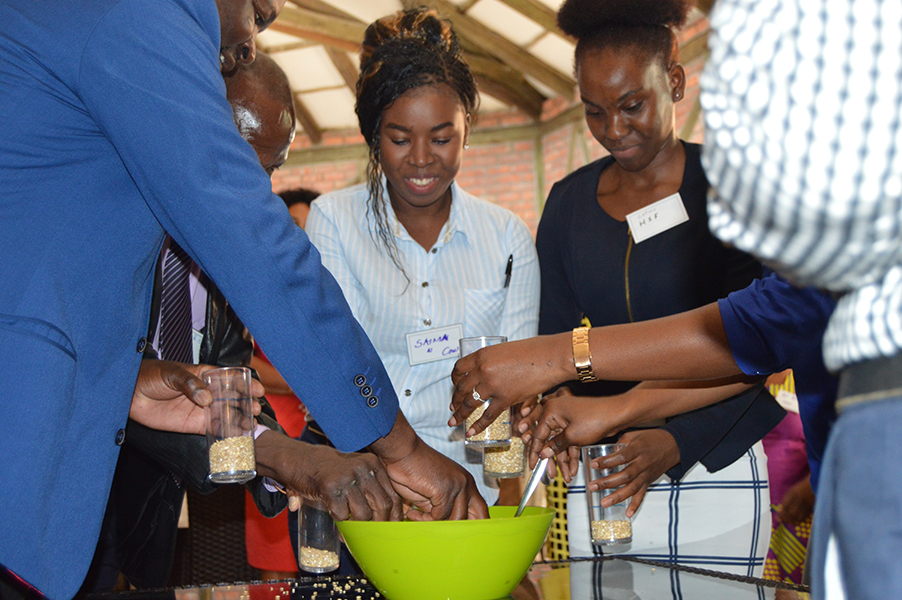
Working at the interface of climate science, urban policy and practice: developing ideas of distillation and receptivity WHEN: 12 June 2018 TIME: 3:00 to 4:30 WHERE: Studio 3, Environmental and Geographical Science Building, Upper Campus, University of Cape Town The last seminar in the 4 part series on cities and climate change will focus on how the worlds of climate science and urban policy making and implementation are being brought closer together in ways that might support more evidence-based decision making on urban matters that are climate sensitive. Drawing primarily on the efforts of, and experiences from, the Future Resilience of African Cities and Lands (FRACTAL) project, the speakers will present ideas and practices of distilling relevant, actionable climate information and fostering greater receptivity to engaging, co-producing and acting on climate information. Central to this is the creation of city learning labs as a space for bringing together a diversity of people and knowledge to generate new thinking and possibly nudge processes of decision making in new directions. Experiences of designing and implementing such labs in Maputo, Lusaka and Windhoek will be discussed in relation to emerging concepts of distillation and receptivity. The seminar will provide an opportunity to share insights about working at science-policy-practice interfaces between those working in the climate space and those working in other urban science-policy domains, like health, water management, housing and biodiversity. CHAIR: Prof Sue Parnell SPEAKERS: Dr Chris Jack, Principal Scientific Officer, Climate System Analysis Group (CSAG), and ACDI Senior Fellow Dr Di Scott, African Centre for Cities Dr Izidine Pinto, Climate System Analysis Group