Food and transnational gastronomic culture amongst Cameroonian migrants in Cape Town and The Hague
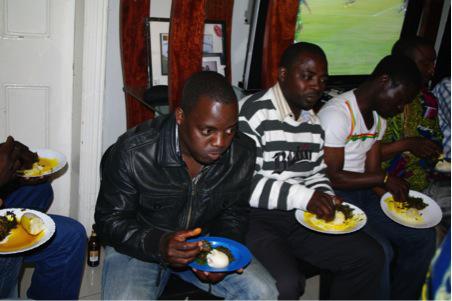
Studio 3 ENGEO Building, Upper Campus. University of Cape Town,, Cape Town, Western Cape, South AfricaIn this seminar, post-doctoral fellow at the African Centre for Cities, Dr Henrietta M Nyamnjoh will present a paper entitled, 'This Christmas I go ‘touch’ some fufu and eru”: Food and transnational gastronomic culture amongst Cameroonian migrants in Cape Town and The Hague'. Abstract Migrants’ relation to ethnic food and their experiences of migration are dynamic processes, experienced in a multiplicity of ways. This paper focuses on how mobility and migration are fast influencing the global food cultures and how increasingly foods are windows into the ways migrants live, think, and identify themselves. Foods are part of migrants’ cultural, historical and even emotional repertoires. Based on ethnographic research amongst Cameroonian migrants in Cape Town and The Netherlands, I explore how migrants travel with their gastronomic culture and/or improvise in the absence of ethnic foods. In the Netherlands, whilst migrants have found ‘home-away-from-home’ through the many shops that sell food from home they still manage to create transnational food chains/links when visiting home. While in Cape Town, despite these shops the absence of certain foods has prompted migrants to improvise and complement their foods, it has also given rise to specialised restaurants that provide Cameroonian cuisine. Through this ethnography I maintain that gastronomic culture can be thought of as a strong bond that affirms migrants’ Cameroonian-ness and keeps them attached to the home country. I question too the extent to which mobility and transnationality reconfigure food experiences amongst migrant communities and argue for multiple understandings of how migrants relate to food to the exclusion of their everyday experience. Bio Henrietta Nyamnjoh is a Post-Doctoral Research Fellow at African Centre for Cities and Environmental and Geographical Science, University of Cape Town. Her research focus is on migration, transnational studies, migrants and urban transformation and religion. She recently completed a study on the use of Information and Communication Technologies amongst Cameroonian migrants in South Africa, The Netherlands and Cameroon. The study (Bridging Mobilities: ICTs appropriation by Cameroonians in South Africa and The Netherlands) seeks to understand migrants’ appropriation of the new Information and Communication Technologies to link home and host country and the wider migrant community. She is also the author of “We Get Nothing from Fishing” Fishing for Boat Opportunities Amongst Senegalese Fisher Migrants (2010). She is currently working on transnational families and emotions amongst Cameroonians in Cape Town.