Hungry Cities Partnership Meeting

UCT Seminar Room 1 Chemical Engineering, UCT Upper Campus, Cape Town, Western Cape, South Africa

Running from the 10th to the 13th of February 2015 is the second project meeting for the Hungry Cities Partnership, an IDRC/SSHRC (Canada) partnership programme within the International Partnership for Sustainable Societies process. The project is a collaboration between Canadian Universities and universities and organisations in the global south. The University of Cape Town is the IDRC grant holder partnering with university partners in Kingston, Jamaica; Mexico City; Maputo and Nanjing, China. Other partners include the African Population and Health Research Centre in Nairobi and the MS Swaminathan Research Foundation in Chennai. The project aims to promote inclusive growth in the informal food economy of cities of the global south.
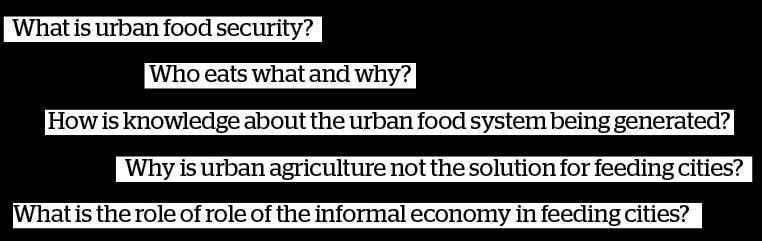
Conference on Informality and the Urban Food System: Policy, practice and inclusive growth through a food lens

UCT Graduate School of Business, V&A Waterfront, Cape Town, Western Cape, South Africa

The Hungry Cities Partnership, a research programme at the African Centre for Cities, will hold a conference at the University of Cape Town’s Graduate School of Business on 15 February 2016. The Hungry Cities Partnership is a research partnership led by the African Centre for Cities at the University of Cape Town and the Balsillie School of International Affairs at Wilfrid Laurier University, Waterloo, Canada. Southern partner cities include Bangalore, Kingston, Maputo, Mexico City, Nairobi, Nanjing and Cape Town. The focus of this five-year research programme is a collaborative, inter-disciplinary research, training and knowledge mobilization programme on urbanization, food security, informality and inclusive growth. See the programme on the AFSUN website.

The Informal Economy’s Role in Feeding Cities – a Missing Link in Policy Debates?

Studio 3 ENGEO Building, Upper Campus. University of Cape Town,, Cape Town, Western Cape, South Africa

Food is fundamental not only to well-being, but to our social and economic lives. Despite this, one of the biggest challenges facing many people in cities all over the world today is hunger. As cities rapidly urbanise, different pressures are placed on the food system which has resulted in the least nutritious food being the most affordable. This seminar series will explore the informal economy, food systems, food security and urbanisation. The first seminar is entitled 'The Informal Economy’s Role in Feeding Cities - A Missing Link in Policy Debates?' and will be presented by Caroline Skinner and Gareth Haysom. Abstract The paper starts by considering the genealogy of the term ‘informal sector’ and then reviews the international context – urbanisation trends and the latest estimates on the size and contribution of the informal economy. The former confirm Crush and Frayne’s contention of the likelihood of an urban future for the majority of Africans and latter suggest that informal work is a predominant source of non-agricultural employment on the most regions of the Global South. Attention is then turned to the South African informal economy, which although smaller than our developing country counterparts, is still a significant source of employment. The informal economy is thus playing a key role in household income – a key aspect of accessibility, particularly in urban areas. The paper then outlines the evidence on the informal economies role in food sourcing of poorer households. The paper critically assesses the current food security policy position in South Africa and the post-Apartheid policy response to the informal economy in general both nationally and in key urban centres. We trace a productionist and rural bias in the food security agenda and argue that the policy environment for informal operators is at best benign neglect and at worse actively destructive. Speaker bios Caroline Skinner is a Senior Researcher at the African Centre for Cities at the University of Cape Town and Urban Policies Research Director for the global action-research-policy network Women in Informal Employment: Globalizing and Organizing (WIEGO). For over 15 years, Skinner’s work has interrogated the nature of the informal economy with a focus on informing advocacy processes and livelihood-centred policy and planning responses. She has published widely on the topic. Dr Gareth Haysom holds a Ph.D in Environmental and Geographic Sciences from UCT. The focus of his Ph.D was on urban food system governance. Gareth is the southern cities project coordinator for the Hungry Cities Partnership project at the ACC. He also works on the Consuming Urban Poverty research project. Venue: Studio 3, EGS Building, Upper Campus, UCT

A systematic review of the literature that focuses on both the ‘informal economy’ and ‘food security’ in South Africa

Studio 3 ENGEO Building, Upper Campus. University of Cape Town,, Cape Town, Western Cape, South Africa

Food is fundamental not only to well-being, but to our social and economic lives. Despite this, one of the biggest challenges facing many people in cities all over the world today is hunger. As cities rapidly urbanise, different pressures are placed on the food system which has resulted in the least nutritious food being the most affordable. This seminar series will explore the informal economy, food systems, food security and urbanisation. The second seminar is entitled 'A systematic review of the literature that focuses on both the ‘informal economy’ and ‘food security’ in South Africa' presented by Candice Kelly and Etai Even-Zahav (Research Fellows at the Sustainability Institute). Abstract Despite the importance of the informal food economy in fulfilling the daily and weekly food needs of a large proportion of South Africa’s low-income population, it appears little research exists on the exact nature of the relationship between the informal food economy and food security. This paper performed the first qualitative systematic review of research from South Africa that addresses both these aspects. The methods used in the review are described in detail, to increase the readers’ ability to assess the reliability of subsequent findings and analysis. Findings confirmed the low level of research focus on the informal food economy (and food security), in particular the stages of the value chain beyond the farm gate and before the consumer. Food safety research is common, although applied narrowly and with mixed findings. The conceptualisation of nutrition research is encouragingly wide, encompassing both over- and under-nutrition, but does not seem to consider the broader urban informal context in which consumers are embedded. Lastly, the research approaches used are predominately quantitative, and the voices of those who survive within the informal food economy are largely absent. Bios Candice Kelly's doctoral research focuses on people leading food system transitions in South Africa. She teaches into the MPhil at the Sustainability Institute, focusing on sustainable food systems. Etai Even-Zahav is also part of the Food Systems team at the Sustainability Institute. He is particularly interested in the informal food economy.

LAUNCH: ‘Tomatoes & Taxi Ranks: Running our Cities to Fill the Food Cap’

The Book Lounge 71 Roeland Street, Cape Town, South Africa

Join ACC for the Cape Town launch of Tomatoes & Taxi Ranks: Running our Cities to Fill the Food Gap, by Leonie Joubert with Jane Battersby and Vanessa Watson published by the African Centre for Cities on Wednesday, 21 November 2018, 17:30 for 18:00 at The Book Lounge, 71 Roeland Street, Cape Town. Author Leonie Joubert will be in conversation with Nancy Richards. The book is based on research conducted by the Consuming Urban Poverty team comprised of urban geographers, sociologists, economists and planners from the African Centre for Cities (ACC) at the University of Cape Town, Copperbelt University in Zambia, the University of Zimbabwe, and the Kisumu Local Interaction Platform (KLIP), in Kisumu, Kenya. Tomatoes & Taxi Ranks, illustrated with evocative photography by Samantha Reinders and Masixole Feni, distills the research into a digestible read and is published alongside the academic book Urban Food Systems Governance and Poverty in African Cities (Routledge, 2018) edited by Jane Battersby and Vanessa Watson. Both book are available as Open Access downloads from www.tomatoesandtaxiranks.org.za Hard copies of the book are available for purchase from The Book Lounge for R150. All proceeds are donated to the Open Box School Library project.