

SDG Seminar: Unpacking SDG implementation in eThekwini

Studio 3 Environmental and Geographical Sciences Building, Upper Campus, UCT, Cape Town, South Africa

Puvendra Akkiah, IDP Manager of eThekwini Municipality and Technical Chair of the United Cities and Local Governments Committee on Urban Strategic Planning, will present a talk entitled Unpacking SDG implementation in eThekwini on Wednesday, 17 April, at 14:00 to 15:30 in Studio 3, Environmental and Geographical Science Building, Upper Campus, UCT. Akkiah will be talking about the City of eThekwini's bottom-up approach to aligning its Integrated Development Plan to the SDGs as part of its strategic approach to sustainability and the advocacy and training activities that the City has undertaken to raise awareness and support for SDG localization. WHEN: 17 April 2019 TIME: 14:00 to 15:30 VENUE: Studio 3, Environmental and Geographical Science Building, Upper Campus, UCT.
How data-ready are African governments to monitor SDG progress?

Davies Reading Room Room 2.27, Environmental and Geographical Science, UCT, Cape Town, Western Cape, South Africa

UCT Datafirst Manager Lynn Woolfrey presents How data-ready are African governments to monitor SDG progress? Zambia and Zimbabwe reviews on Wednesday, 15 May at 12:30 to 14:00 in Davies Library, Environmental and Geographical Science Building, Upper Campus, UCT. ABSTRACT It is clear from the development literature that Sustainable Development Goal (SDG) plans must include the building of efficient development data ecosystems (OECD, 2015, p. 16). Such systems can provide governments with country-level indicators for SDG planning and monitoring. For example, the UN Economic Commission for Africa’s Africa Data Consensus suggests that official and other data producers partner to create an international data ecosystem for development planning (UNECA, 2015, p. 2).  In 2017 the UN Development Programme (UNDP) adopted such an ecosystems approach to conduct data audits with African governments. The audits assess a government’s “SDG indicator readiness”- whether accurate and current data is available to compile their SDG indicators – and investigate causes and solutions. The UNDP has found ecosystems mapping useful to expose the causes of poor quality national statistics, such as inadequate funding and bureaucratic resistance to change (Menon, 2017, pp. 12-13, 20). This seminar presents the findings of two SDG indicator readiness audits, in Zambia and Zimbabwe, and comment on the outcomes, and the value and shortcomings of these audits for development data capacity-building in African countries. WHEN: Wednesday, 15 May 2019 TIME: 12:30 to 14:00 VENUE: Davies Library, Level 2, Environmental and Geographical Science Building, Upper Campus, UCT.
SDG Seminar Series: Financing the SDGs in African cities?

Davies Reading Room Room 2.27, Environmental and Geographical Science, UCT, Cape Town, Western Cape, South Africa

The fourth instalment of the ACC SDG Seminar is presented by Liza Rose Cirolia on Wednesday, 19 June 2019 at 12:30 to 14:00 in the Davies Room, Environmental and Geographical Sciences Building, Upper Campus, UCT. Entitled Financing the SDGs in African cities?, her seminar will explore the fiscal constraints and opportunities for local government to participation in global agendas. WHEN: Wednesday, 19 June 2019 TIME: 12:30 to 14:00 VENUE: Davies Room, Environmental and Geographical Sciences Building, Upper Campus, UCT.

SDG Seminar Series: SDG indicators for health outcomes in South Africa

Aadil Moerat Seminar Room, Barnard Fuller Room Health Science Campus, Anzio Road, Observatory, Cape Town . , South Africa

Next up in the ACC seminar series on the Sustainable Development Goals, Associate Professor Salome Maswime will present SDG indicators for health outcomes in South Africa on Wednesday, 18 September 2019 from 12:30 to 14:00. Maswime is Head of Global Surgery in the Surgery Division at the Faculty of Health Sciences, University of Cape Town. WHEN: Wednesday,  18 September 2019 TIME: 12:30 to 14:00 VENUE: Aadil Moerat Seminar Room, Barnard Fuller Room, Health Science Campus, Anzio Road, Observatory RSVP:  Please rsvp to clare.jeffrey@uct.ac.za by 13 September 2019  

UCT SDG Summit | Circular Economy Pre-Summit Workshops

The Vice Chancellor of the University of Cape Town is convening an international summit on how the SDGs can best be realised in the African context with an eye on the role of science and mission-driven partnerships. In the build-up to the Summit, a series of workshops are being organised around seven themes, of which the Circular Economy is one. READ THE CONCEPT NOTE HERE WORKSHOP 1 | 17 August, 14:00 to 16:15 The first workshop will explore the definitional debates around the circular economy with an emphasis on the state of macro scholarship and policy positions adopted by select African governments and civil society actors. Speakers Prof Ester van der Voet – Leiden University & UN International Resource Panel Dr Willi Haas – BOKU, Vienna Bezawit Eshetu – African Circular Economy Network Reniera O’Donnell – Higher Education Lead at Ellen MacArthur Foundation Register here WORKSHOP 2 | 31 August, 14:00 to 16:15 The second workshop will be an exploration of circular economy applications through case studies with an eye on research questions and issues. Speakers Prof Christina Trois – University of KwaZulu-Natal Kirsten Barnes – GreenCape Paul Currie – ICLEI Africa Sudhir Pillay – Water Research Commission Prof Harro von Blottnitz – University of Cape Town Register here These workshops are open to all who are involved in Circular Economy related work and research.

UCT SDG Summit | An Urban Lens on the Achievement of the SDGs

A Masterclass alongside the UCT SDG Africa Summit 2021The ACC Masterclass will be structured in three parts, comprised of 75min each. The first session will unpack the political and institutional backstory in ensuring that there was an SDG to address the imperatives of urbanisation, and connections were drawn with other SDGs. The second session will focus on the complexities and contradictions of implementing the SDGs when it is a nexus issue such as urban food security. The analytical focus will fall on the challenge of effective inter-governmental coordination and alignment across scales and sectors. The third session will focus on the practical policy tools that are being deployed at city-level to track the implementation of the SDGs at the local level, considered against the national reporting system of the South African government. This raises institutional questions about fostering a shared perspective when municipal officials remain deeply commitment to sectoral specialisms, as well as issues about alignment and meaningful societal engagement in tracking government performance in delivering on stated commitments. Across the three sessions participants will be exposed to the cutting edges of the interface between applied research and policy implementation. Session 1 | The genesis of SDG 11: Getting the urban onto the agenda10:00 to 11:15Edgar Pieterse (ACC) in conversation with Aromar Revi (Indian Institute for Human Settlements) and Monika Glinzler (International relations, Department of Human Settlements) By some estimates, getting the urban question right is a precondition to achieve up to 70% of the overall SDG agenda. However, until the last hour before the finalisation of the seventeen SDGs, there was great doubt that an explicit urban goal would be included. This session will pull the curtain on the backstage advocacy arguments, evidence and diplomatic work that was conducted to secure an urban perspective across the SDGs. It is a given that the multilateral system is not perfect, but for those on the frontlines of policy mainstreaming, it is indispensable and a permanent site of struggle.  Session 2 | Teasing out the tensions: SDGs as a national imperative, and SDG 11 as a city-level goal11:30 to 12:45Gareth Haysom (ACC) in conversation with Jane Battersby (University of Cape Town) and Julian May (University of the Western Cape)  The urban food lens offers a unique scalar perspective bringing the tensions and opportunities presented at the intersection between zero hunger (SDG 2), and sustainable cities (SDG 11), as well as health and well-being (3), education (4) and gender equality (5). The session will engage in both the challenges presented at these intersections between nexus and scalar issues, while attempting to engage the complexities and contradictions of implementing and measuring the SDGs when it is a nexus issue such as urban food and nutrition security, and what this might mean in context, but equally, effective inter-governmental coordination and alignment across scales and sectors.  Session 3 | Lessons towards SDG localisation and indicators14:00 to 15:15Andrew Tucker (ACC) in conversation with Alexis Schäffler-Thomson (Pegasys) and Natasha Primo (City of Cape Town)   It is a given that the SDGs will only find full expression if they become the focus of local action, established within enabling national parameters. There is great potential in using indicator frameworks and monitoring systems to establish productive alignment between national and local governments. This session will share research findings and potential of using local level indicator frameworks to track and reflect on policy efforts to implement the SDGs, whilst being mindful of the statistical challenges of generating local level data. The empirical reference point will be South Africa and Cape Town. 

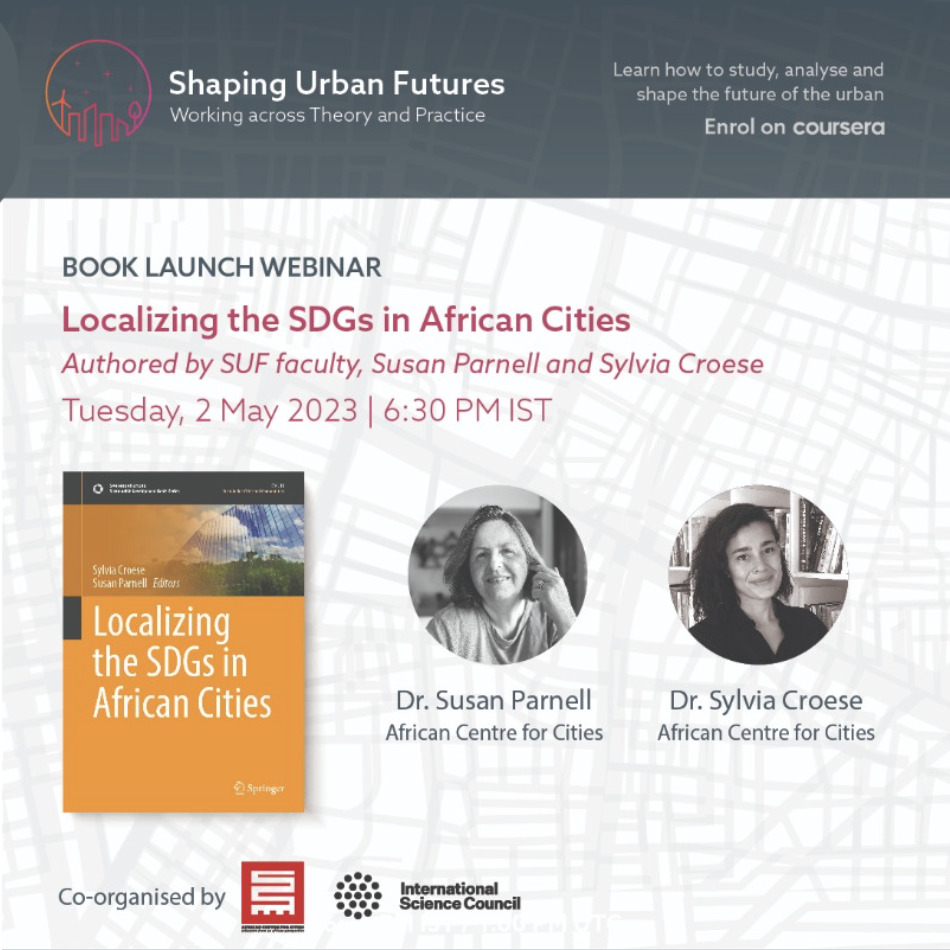
WEBINAR | Localizing the SDGs in African Cities

On the first UN Science, Technology and Innovation in Africa Day, 2 May 2023the International Science Council together with the African Centre for Cities present webinar aimed at exploring effective ways of accelerating local action towards the implementation of the SDGs in African cities.