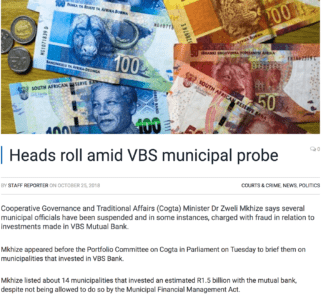



Bushbuckridge mayor embarks on debt collection exercise “The municipality has disclosed that it is owed R1 billion in unpaid municipal services such as water supply, refuse removal and property rates.” – Mpumalanga News, 1 October 2018 Heads Roll Amid VBS Municipal Probe “Cooperative Governance and Traditional Affairs (Cogta) Minister Dr Zweli Mkhize says several municipal officials have been suspended and in some instances, charged with fraud in relation to investments made in VBS Mutual Bank.” – AllAfrica.com 23 October 2018 Join African Centre for Cities on Monday, 19 November 2018, from 15:00 to 17:00 for a lecture by Dr Matthew Glasser on public finance. Across the globe, there is increasing emphasis on the role of cities and local government in delivering services, meeting the Sustainable Development Goals, addressing climate change, and equalizing opportunity. These assigned roles do not often translate into reality. Many South African municipalities are failing to provide effective services to their residents. Part of the reason for this are the regular financial crises which local governments face. Importantly, South Africa is one of very few countries in the world that has specific legislation intended to resolve fiscal problems at the municipal scale. This legislation is little known and little used. In 2000-2003, Dr Matthew Glasser helped develop the legislation regarding financial problems in municipalities, as reflected in Section 139 (as amended) of the Constitution, and Chapter 13 of the Municipal Finance Management Act. For the last two years, he has been working with National Treasury to take stock of the implementation of those provisions over the intervening 15 years. At this seminar, we will discuss the legal and regulatory framework that was developed to deal with financial emergencies in South African cities; review the experience to date with implementation of that framework; and reflect on the ways in which South Africa’s social and political context shapes local implementation. Glasser will discuss the genesis of the legislation, the divergence between legal framework and actual implementation, and the important Emalahleni litigation related to fiscal intervention in municipalities, which has set an important precedent in South Africa. There will be ample time to discuss the fiscal challenges of South African local and city government, following the lecture. WHEN: Monday, 19 November 2018 TIME: 15:00 to 16:30 VENUE: Studio 1, Environmental and Geographical Science Building, Upper Campus, UCT
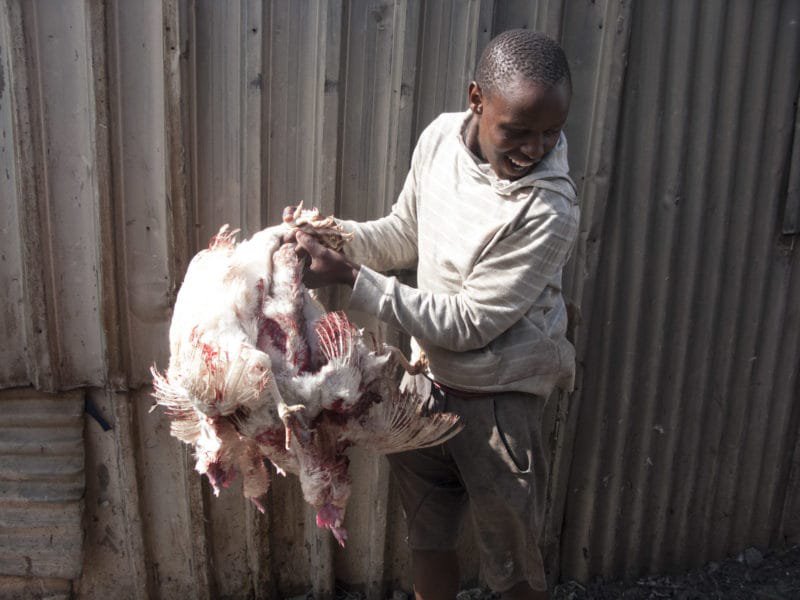
Join ACC for the Cape Town launch of Tomatoes & Taxi Ranks: Running our Cities to Fill the Food Gap, by Leonie Joubert with Jane Battersby and Vanessa Watson published by the African Centre for Cities on Wednesday, 21 November 2018, 17:30 for 18:00 at The Book Lounge, 71 Roeland Street, Cape Town. Author Leonie Joubert will be in conversation with Nancy Richards. The book is based on research conducted by the Consuming Urban Poverty team comprised of urban geographers, sociologists, economists and planners from the African Centre for Cities (ACC) at the University of Cape Town, Copperbelt University in Zambia, the University of Zimbabwe, and the Kisumu Local Interaction Platform (KLIP), in Kisumu, Kenya. Tomatoes & Taxi Ranks, illustrated with evocative photography by Samantha Reinders and Masixole Feni, distills the research into a digestible read and is published alongside the academic book Urban Food Systems Governance and Poverty in African Cities (Routledge, 2018) edited by Jane Battersby and Vanessa Watson. Both book are available as Open Access downloads from www.tomatoesandtaxiranks.org.za Hard copies of the book are available for purchase from The Book Lounge for R150. All proceeds are donated to the Open Box School Library project.
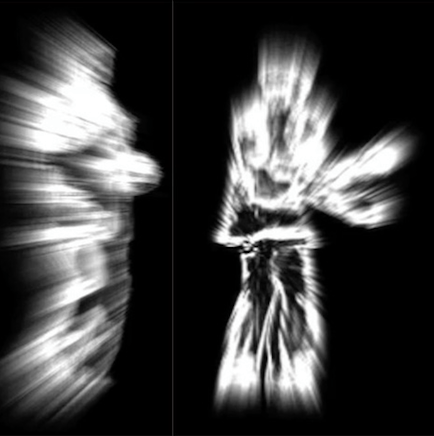
Join ACC's PhD candidate heeten bhagat for 'this image may contain' - a visual articulation of research in speculative indigeneities on Wednesday, 21 November 2018, 18:00 at The Quad, The Arena Theatre. The aim of this doctoral research was to attempt an interdisciplinary approach to search for registers (and absences) of indigeneity through a close reading of the 2017 Independence day celebration, held at the National Sports Stadium in Harare, Zimbabwe. The focus of this study was motivated by two distinct elements from the event: The first is a banner that hangs over the official entrance to the performance arena, that declares – ‘ZIMBABWE WILL NEVER A BE COLONY AGAIN’. The second element is a fragment from the president’s address to the nation at this ceremony, which proclaims, "…..we can now call ourselves full the masters of our destiny". This works on show constitute the concluding articulation of this research journey into notions of speculative and speculating indigeneities.