The urban network strategy – the panacea for urban and developmental ills?
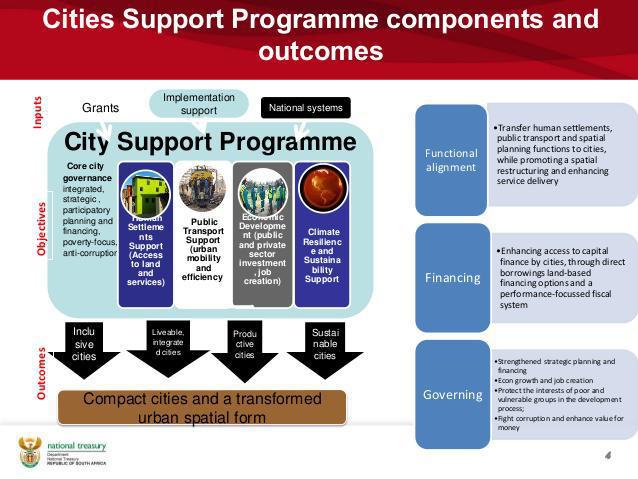
Seminar Room 1 Environmental & Geographical Sciences Building, UCT Upper CampusThe ACC looks forward to generating a stimulating debate about the Cities Support Programme by hosting Dr Paul Hendler from iNSITE who will be presenting a paper co-authored by himself and Dr Arumugam Pillay (who will be present via Skype) entitled, 'The urban network strategy - the panacea for urban and developmental ills'. Abstract The National Treasury, through its Cities Support Programme (CSP), intends to get the eight metropolitan municipalities to run more efficiently, become financially and ecologically sustainable and give the majority of their citizens access to employment and public and social amenities. The weakness of the strategy is its assumption of the inevitable upswing in the global business cycle, the ability of cities to afford the infrastructure required for ongoing in-migration and the fact that it omits describing how broad-based, inclusive and eco-sensitive economic development with significant employment opportunities should happen. The missing factor in the programme is state intervention aimed at economic restructuring: it simply assumes that both job creation and green manufacturing will happen without explaining how. Instead, the paper argues that the challenge is to address the broader political economy context of sluggish growth, low wages and high unemployment, in order to support key CSP objectives. In this regard, the paper identifies specifically the need for municipalities as public sector developers to directly support2 improved quality of life and work opportunities for both the urban and rural working classes, and for the state to stem the outflow of funds from the country, re-direct investment funds away from finance, insurance and real estate (the jobless growth sectors) and into manufacturing and implement a coherent rural development based on technical and financial support for feasible ‘accumulation from below’ by current smallholder farmers and households in traditional areas. Bio Dr Paul Hendler is an extraordinary senior lecturer at the University of Stellenbosch's School of Public Management, and a founder of iNSITE that is working (through the Sustainability Institute, Stellenbosch University) on the formulation of a financial mechanism for the investment of a civil society green savings fund in South Africa. Hendler has been researching the intersection of housing and the political economy for over 30 years in South Africa, with an emphasis on critiquing neoliberal development. Dr Arumugam (Morgan) Pillay is CEO of The Ekurhuleni Development Company. He is responsible for delivery of finance to and Social Housing. Pillay has almost 25 years of experience in Infrastructure Development and Finance within the government sector. Having worked at the National Housing Finance Corporation, Standard Corporate and Merchant Bank, and advising national and provincial government departments, he is one of South Africa’s housing finance experts that has both theoretical and practical experience in the sector.