SEMINAR | Housing Opportunities for All

ACC together with the Development Action Group (DAG), will be hosting a seminar entitled Housing Opportunities for All, presented by Dr Krista Paulsen and Dr Vanessa Fry, both fellows of the Mandela Washington Fellowship Programme.

On tactical planning

African Centre for Cities hosts visiting scholar Marco Di Nunzio for a seminar entitled On tactical planning, on Thursday, 11 May 2023, from 13:00-14:00. 

Lived experience as a pathway to community agency? Toward new framings of nutrition in urban South Africa

The Nourished Child project took a lived experience approach to understanding how systems interacted in the lives of women to shape their and their children's quality of diet. Central to the project was the development of a range of creative dissemination tools to engage policy makers, and increase community agency. In this presentation Jane Battersby reflects on the process, politics, and outcomes of the project, and the potential of projects of this kind to affect long term transformative change. Ahead of the presentation, you can also view the Nourished Child exhibition in the foyer of the Environmental and Geographical Sciences Building. WHEN | Monday, 15 May 2023 TIME | 13:00-14:00 VENUE |Studio 3, Environmental and Geographical Sciences Building, Upper Campus, UCT

ACC Brown Bag – Living Off-Grid: Reflections from Ghana and Zimbabwe

Studio 1, Environmental and Geographical Science Building, Upper Campus, UCT

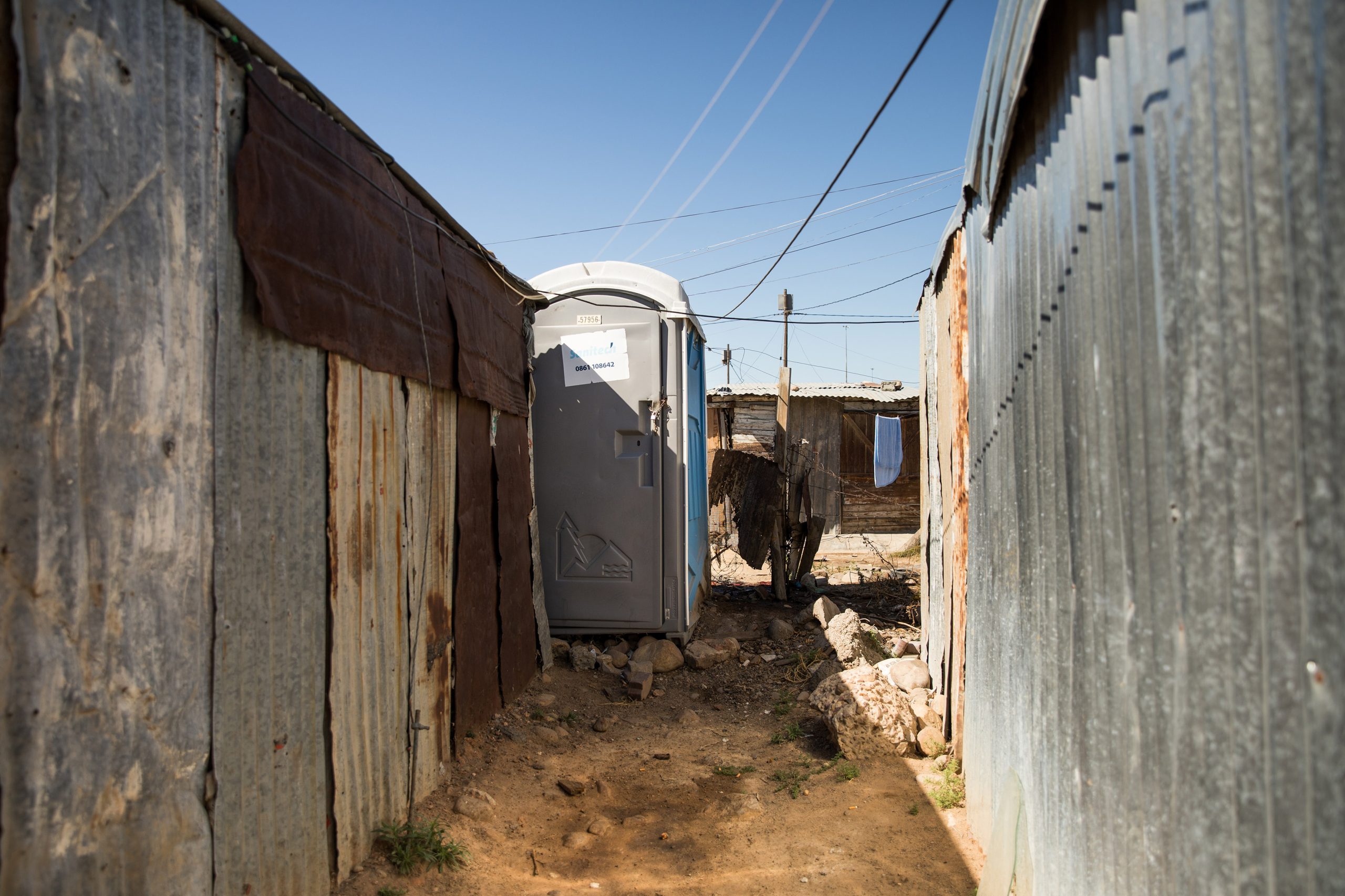
Speakers: Percy Toriro – University of Zimbabwe and Issahaka Fuseini – University of Ghana Join this discussion between Percy Toriro and Issahaka Fuseini, who will share findings from their work as city partners in the LOGIC (off-grid) project. Percy will engage the theme of ‘Electricity visits us’: the challenges of living with poor infrastructure and services in an off-grid settlement, with a focus on Dzivarasekwa, Zimbabwe. Issahaka will speak to the realities of off-griddedness and various assemblages to adapt to water scarcity and sanitation challenges in Tamale, Ghana. These inputs will be followed by reflections by Hayley MacGregor (IDS) locating these discussions within the overlooked intersections between urban studies, the “infrastructure turn” and emerging urban food, nutrition and wider wellbeing debates. This brownbag will build on the earlier conversations by Mercy Brown Luthango and Iromi Perera and the LOGIC (off grid) project, speaking to research in two additional project cities. WHEN: Thursday, 11 April 2024 TIME: 15h30 - 16h30 VENUE: Studio 1, Environmental and Geographical Sciences Building, Upper Campus, University of Cape Town ABOUT THE SPEAKERS Percy Toriro has over 20 years’ experience as a city planner, having been the Chief Planner for the City of Harare for 10 years. Dr Toriro also leads the Urban Planning Program at the Municipal Development Partnership (MDP) a network spanning 15 Southern African countries, engaging in urban development challenges. Percy holds a PhD from the University of Cape Town. His research has covered urban infrastructure, urban housing, urban informality, housing, governance, food systems and environment. Percy’s work sees him interacting with national, regional and local governments in different countries and cities. Percy served four terms as President of the Zimbabwe Institute of Regional and Urban Planners (ZIRUP). Percy holds an adjunct lectureship position at the University of Zimbabwe. Issahaka Fuseini is a senior lecturer at the University of Ghana, Ghana. Issahaka holds a PhD from Stellenbosch University. Issahaka’s research interest spans food systems governance, collaborative local-level governance, and inclusive urban development. Issahaka previously worked at the African Centre for Cities, University of Cape Town, during which time he was involved in multi-country, interdisciplinary projects aimed at improving urban food systems governance and nutrition security in nine cities in Kenya, Zambia, Zimbabwe, Namibia, and South Africa. Presently, Issahaka is a co-investigator responsible for the Ghanaian component of a UKRI-sponsored multi-country research project (under the Global Challenges Research Fund’s Off-Grid Cities call) that is being implemented in five cities in Ghana, South Africa, Zimbabwe, India, and Sri Lanka. This project seeks to understand how access to or the lack of infrastructure, broadly defined, impacts the food and nutrition security of marginalised populations in cities in the Global South. Issahaka is also a lead partner in a city dialogue, facilitated by RUAF/FAO, that is aimed at developing a city-level food systems governance agenda for his home city of Tamale, Ghana.


Brownbag seminar_ACCRETION THROUGH FRICTION: examining garbage flows in Dakar’s Baie de Hann

Studio 1, Environmental and Geographical Science Building, Upper Campus, UCT

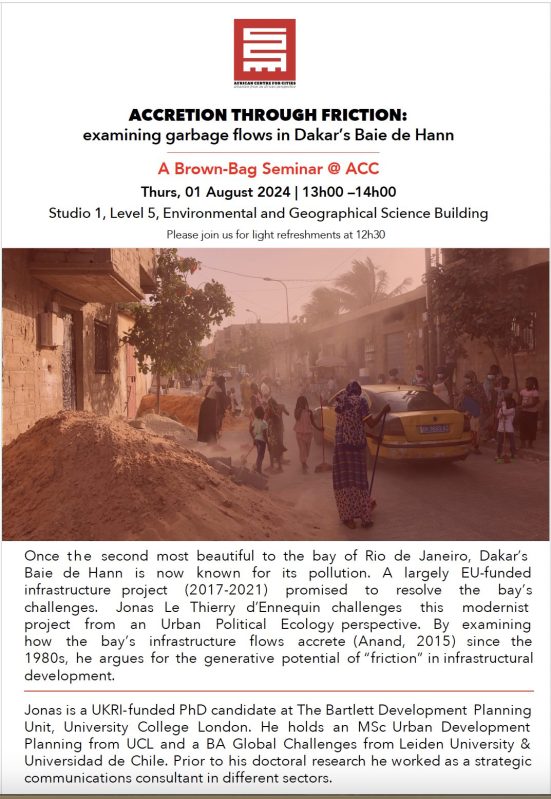
Once the second most beautiful to the bay of Rio de Janeiro, Dakar’s Baie de Hann is now known for its pollution. A largely EU-funded infrastructure project (2017-2021) promised to resolve the bay’s challenges. Jonas Le Thierry d’Ennequin challenges this modernist project from an Urban Political Ecology perspective. By examining how the bay’s infrastructure flows accrete (Anand, 2015) since the 1980s, he argues for the generative potential of “friction” in infrastructural development. Details: Date: Thursday, 01 August 2024 Time: 12h30 –14h00 Venue: Studio 1, Level 5, Environmental and Geographical Science Building Jonas is a UKRI-funded PhD candidate at The Bartlett Development Planning Unit, University College London. He holds an MSc Urban Development Planning from UCL and a BA Global Challenges from Leiden University & Universidad de Chile. Prior to his doctoral research he worked as a strategic communications consultant in different sectors.

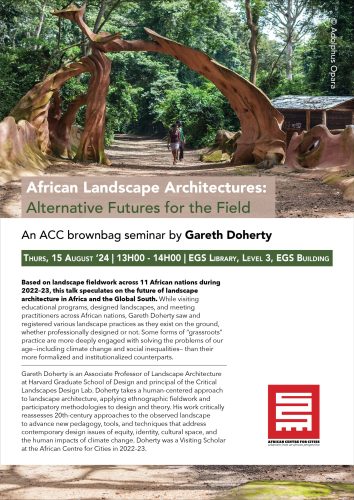
Brownbag seminar: African Landscape Architectures_Alternative futures for the field

EGS Library, EGS Building, Upper Campus, UCT

Based on landscape fieldwork across 11 African nations during 2022–23, this talk speculates on the future of landscape architecture in Africa and the Global South. While visiting educational programs, designed landscapes, and meeting practitioners across African nations, Gareth Doherty saw and registered various landscape practices as they exist on the ground, whether professionally designed or not. Some forms of “grassroots” practice are more deeply engaged with solving the problems of our age—including climate change and social inequalities— than their more formalized and institutionalized counterparts. Details: Date: Thursday, 15 August 2024 Time: 13h00 –14h00 Venue: EGS Library, EGS Building, Upper Campus, UCT About the presenter: Gareth Doherty is an Associate Professor of Landscape Architecture at Harvard Graduate School of Design and principal of the Critical Landscapes Design Lab. Doherty takes a human-centered approach to landscape architecture, applying ethnographic fieldwork and participatory methodologies to design and theory. His work critically reassesses 20th-century approaches to the observed landscape to advance new pedagogy, tools, and techniques that address contemporary design issues of equity, identity, cultural space, and the human impacts of climate change. Doherty addresses these issues through research on designed landscapes across the postcolonial and Islamic worlds. Through what he terms “landscape fieldwork,” Doherty unravels diverse landscape narratives that have not yet been formally documented as evidenced through his books, Paradoxes of Green: Landscapes of a City-State (University of California Press, 2017), Landscape Fieldwork: How the Engaging the World Changes Design (University of Virginia Press, forthcoming), and his recent fieldwork on African landscape architecture. Doherty was a Visiting Scholar at the African Centre for Cities in 2022–23.