Urban Humanities: Contextualising strategies to enable LGBT rights in Africa: legitimacies, spatial inequalities and socio-spatial relationships

Studio 3 Environmental and Geographical Sciences Building, Upper Campus, UCT, Cape Town, South Africa

Join us for the an Urban Humanities academic seminar entitled Contextualising strategies to enable LGBT rights in Africa: legitimacies, spatial inequalities and socio-spatial relationships, by Dr Andrew Tucker on Thursday, 1 November 2018 at 15:00. ABSTRACT This paper explores the potential benefits of relationally considering the efficacy of radically different strategies to support LGBT rights in Africa. While a great deal has been written about the deployment of human rights-based framings to support LGBT needs on the continent, less attention has been paid to other emergent strategies based around HIV/AIDS programming and economic development initiatives. This paper sets out a schema to consider the relational nature of these different strategies and highlights how such a schema can also enable researchers to better understand how civil society groups strategically and pragmatically harness different approaches in particular places and at particular times. WHEN: Thursday, 1 November 2018 TIME: 15:00 to 16:30 VENUE: Studio 3, Environmental and Geographical Sciences Building, Upper Campus, UCT

SDGs Seminar Series: Localizing the SDGs in South Africa

Environmental and Geographical Science Building South Lane, Upper Campus, UCT, Cape Town, Western Cape, South Africa

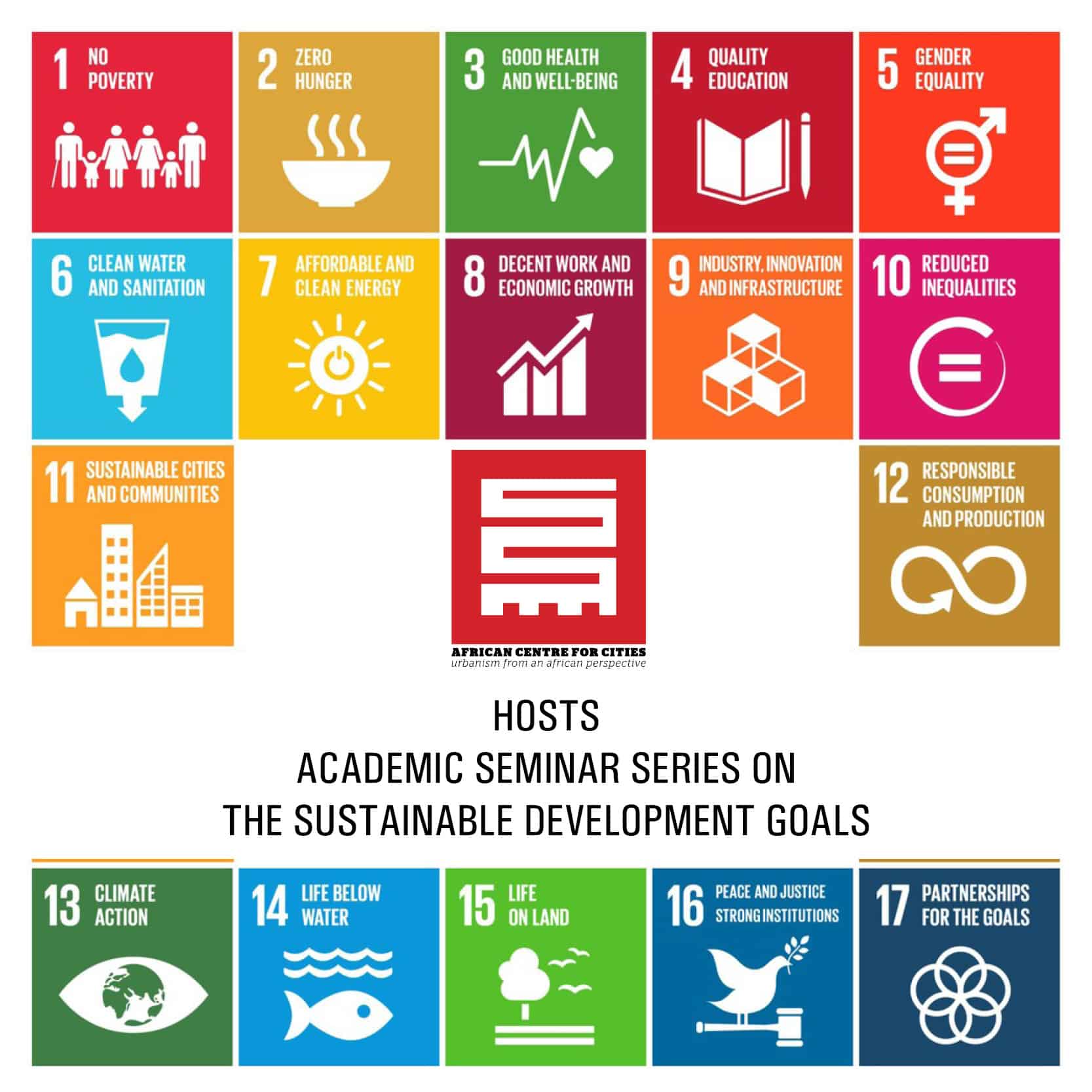
Over the course of the next semester African Centre for Cities will be curating and hosting a series of seminars and discussions on the Sustainable Development Goals. The series kicks-off with Dr Sylvia Croese with a seminar on Localizing the SDGs in South Africa on Wednesday, 13 February 2019, at 12:30 to 14:00 in the Environmental and Geographical Sciences Building, Upper Campus, University of Cape Town. The inclusion of a standalone urban goal as part of the 17 SDGs adopted in 2015 represents the culmination of the growing recognition and acknowledgement of the importance of cities as both drivers and actors in achieving sustainable development. However, nearly four years down the line very little is known about the ways in which local governments are going about the implementation and monitoring of the SDGs. This presentation draws on on-going research in and with the City of Cape Town to shed some light on some of the factors and conditions that may limit or enable SDG localization. It kicks off a series of seminars that will be held on a monthly basis throughout 2019 on the challenges and opportunities for SDG implementation in (South) Africa. WHEN: Wednesday, 13 February 2019 TIME: 12:30 to 14:00 VENUE: Environmental and Geographical Sciences Building, Upper Campus, UCT
Bad Health in a Good Retreat: Life and Death in the ‘Worst’ Neighborhood of São Paulo, Brazil

Studio 1 Environmental and Geographical Sciences Building, Upper Campus, UCT, Cape Town, South Africa

Prof Jeffrey Lesser will be presenting a seminar entitled Bad Health in a Good Retreat: Life and Death in the 'Worst' Neighborhood of São Paulo, Brazil, on Monday, 25 February 2019, 12:30 to 14:00, in the Studio 1, Environmental and Geographical Science Building, Upper Campus, UCT. ABSTRACT Bom Retiro was (and is) a small neighborhood in the huge megalopolis of São Paulo, Brazil.  The mainly working class neighborhood has been populated since the end of the 19th century by immigrants, migrants from the impoverished Brazilian northeast, and Afro-Brazilian descendants of slaves. While the cultural backgrounds of the immigrants have shifted (from Italians, Spaniards and Portuguese Catholics in the early 20th century to East European Jews in the mid-20th century to Chinese, Korean, Paraguayan, and Bolivian immigrants today), the neighborhood has been viewed internally and externally as one where health (in the broadest sense of the word) is precarious. “Bad Health in a Good Retreat” analyzes the relationship between “Public Health” (as a state driven set of policies and linked enforcement) and “The Public’s Health” (how real people understand their own experiences).   By focusing on one square block of Bom Retiro from about 1900 to the present I use archival and ethnographic methods to analyze the daily practices of residents and health officials, and the stories they tell about life, death, and the spaces in between. BIOGRAPHY Jeffrey Lesser is Samuel Candler Dobbs Professor of Brazilian Studies and Director of Emory University’s Halle Institute for Global Research.  His research focus is on the construction of national identity in Brazil, focusing on how immigrant and ethnic groups understand their own and national space.   Lesser is the author of numerous prize winning books including, Immigration, Ethnicity and National Identity in Brazil (Cambridge University Press) A Discontented Diaspora: Japanese-Brazilians and the Meanings of Ethnic Militancy (Duke University Press); Negotiating National Identity: Immigrants, Minorities and the Struggle for Ethnicity in Brazil (Duke University Press);  and Welcoming the Undesirables: Brazil and the Jewish Question (University of California Press). 

SDG Seminar: Unpacking SDG implementation in eThekwini

Studio 3 Environmental and Geographical Sciences Building, Upper Campus, UCT, Cape Town, South Africa

Puvendra Akkiah, IDP Manager of eThekwini Municipality and Technical Chair of the United Cities and Local Governments Committee on Urban Strategic Planning, will present a talk entitled Unpacking SDG implementation in eThekwini on Wednesday, 17 April, at 14:00 to 15:30 in Studio 3, Environmental and Geographical Science Building, Upper Campus, UCT. Akkiah will be talking about the City of eThekwini's bottom-up approach to aligning its Integrated Development Plan to the SDGs as part of its strategic approach to sustainability and the advocacy and training activities that the City has undertaken to raise awareness and support for SDG localization. WHEN: 17 April 2019 TIME: 14:00 to 15:30 VENUE: Studio 3, Environmental and Geographical Science Building, Upper Campus, UCT.

How data-ready are African governments to monitor SDG progress?

Davies Reading Room Room 2.27, Environmental and Geographical Science, UCT, Cape Town, Western Cape, South Africa

UCT Datafirst Manager Lynn Woolfrey presents How data-ready are African governments to monitor SDG progress? Zambia and Zimbabwe reviews on Wednesday, 15 May at 12:30 to 14:00 in Davies Library, Environmental and Geographical Science Building, Upper Campus, UCT. ABSTRACT It is clear from the development literature that Sustainable Development Goal (SDG) plans must include the building of efficient development data ecosystems (OECD, 2015, p. 16). Such systems can provide governments with country-level indicators for SDG planning and monitoring. For example, the UN Economic Commission for Africa’s Africa Data Consensus suggests that official and other data producers partner to create an international data ecosystem for development planning (UNECA, 2015, p. 2).  In 2017 the UN Development Programme (UNDP) adopted such an ecosystems approach to conduct data audits with African governments. The audits assess a government’s “SDG indicator readiness”- whether accurate and current data is available to compile their SDG indicators – and investigate causes and solutions. The UNDP has found ecosystems mapping useful to expose the causes of poor quality national statistics, such as inadequate funding and bureaucratic resistance to change (Menon, 2017, pp. 12-13, 20). This seminar presents the findings of two SDG indicator readiness audits, in Zambia and Zimbabwe, and comment on the outcomes, and the value and shortcomings of these audits for development data capacity-building in African countries. WHEN: Wednesday, 15 May 2019 TIME: 12:30 to 14:00 VENUE: Davies Library, Level 2, Environmental and Geographical Science Building, Upper Campus, UCT.

SDG Seminar Series: Financing the SDGs in African cities?

Davies Reading Room Room 2.27, Environmental and Geographical Science, UCT, Cape Town, Western Cape, South Africa

The fourth instalment of the ACC SDG Seminar is presented by Liza Rose Cirolia on Wednesday, 19 June 2019 at 12:30 to 14:00 in the Davies Room, Environmental and Geographical Sciences Building, Upper Campus, UCT. Entitled Financing the SDGs in African cities?, her seminar will explore the fiscal constraints and opportunities for local government to participation in global agendas. WHEN: Wednesday, 19 June 2019 TIME: 12:30 to 14:00 VENUE: Davies Room, Environmental and Geographical Sciences Building, Upper Campus, UCT.

SDG Seminar Series: SDG indicators for health outcomes in South Africa

Aadil Moerat Seminar Room, Barnard Fuller Room Health Science Campus, Anzio Road, Observatory, Cape Town . , South Africa

Next up in the ACC seminar series on the Sustainable Development Goals, Associate Professor Salome Maswime will present SDG indicators for health outcomes in South Africa on Wednesday, 18 September 2019 from 12:30 to 14:00. Maswime is Head of Global Surgery in the Surgery Division at the Faculty of Health Sciences, University of Cape Town. WHEN: Wednesday,  18 September 2019 TIME: 12:30 to 14:00 VENUE: Aadil Moerat Seminar Room, Barnard Fuller Room, Health Science Campus, Anzio Road, Observatory RSVP:  Please rsvp to clare.jeffrey@uct.ac.za by 13 September 2019  

SDG SEMINAR: Citizen-centric approaches to achieving the SDGs in Africa: reflections from practice

John Martin Boardroom New Engineering Building, Cape Town

Namhla Mniki will present Citizen-centric approaches to achieving the SDGs in Africa: reflections from practice on 23 October, from 12:30 to 14:00 as part of ACC's on-going SDG Seminar series. Namhla Mniki is a global development strategist leading African Monitor, an entity working to eradicate poverty, to create economic opportunities, and to empower African citizens to drive the achievement of sustainable development goals in Africa. She specialises in citizen-centric sustainable approaches to development that promote accountable leadership and good governance in Africa and beyond.  Namhla is a global activist and speaker, having addressed high-level audiences from the United Nations to Heads of State in Africa and Europe.  She has worked extensively with various arms of the United Nations, including her current role as Cepei’s Expert Panel on United Nations Regional Review.  She is a patron for the Africa Youth SDGs Summit, a Global Peer Review Expert for the German government, and a member of the expert team for the Africa Progress Group and the World Economic Forum Africa. Her latest work focusses on increasing knowledge of and building capacity for co-creation and collaboration across government, business and civil society to implement sustainable development strategies. She has a strong belief that a new paradigm of development delivery can benefit the world, focusing on innovation, collaboration, multi-sectoralism, co-creation, and broad participation. WHEN: 23 October 2019 TIME: 12:30 to 14:00 VENUE: John Martin Boardroom, Level 5, New Engineering Building, Upper Campus, UCT  

Academic Seminar: The edge economies of migration

Davies Reading Room Room 2.27, Environmental and Geographical Science, UCT, Cape Town, Western Cape, South Africa

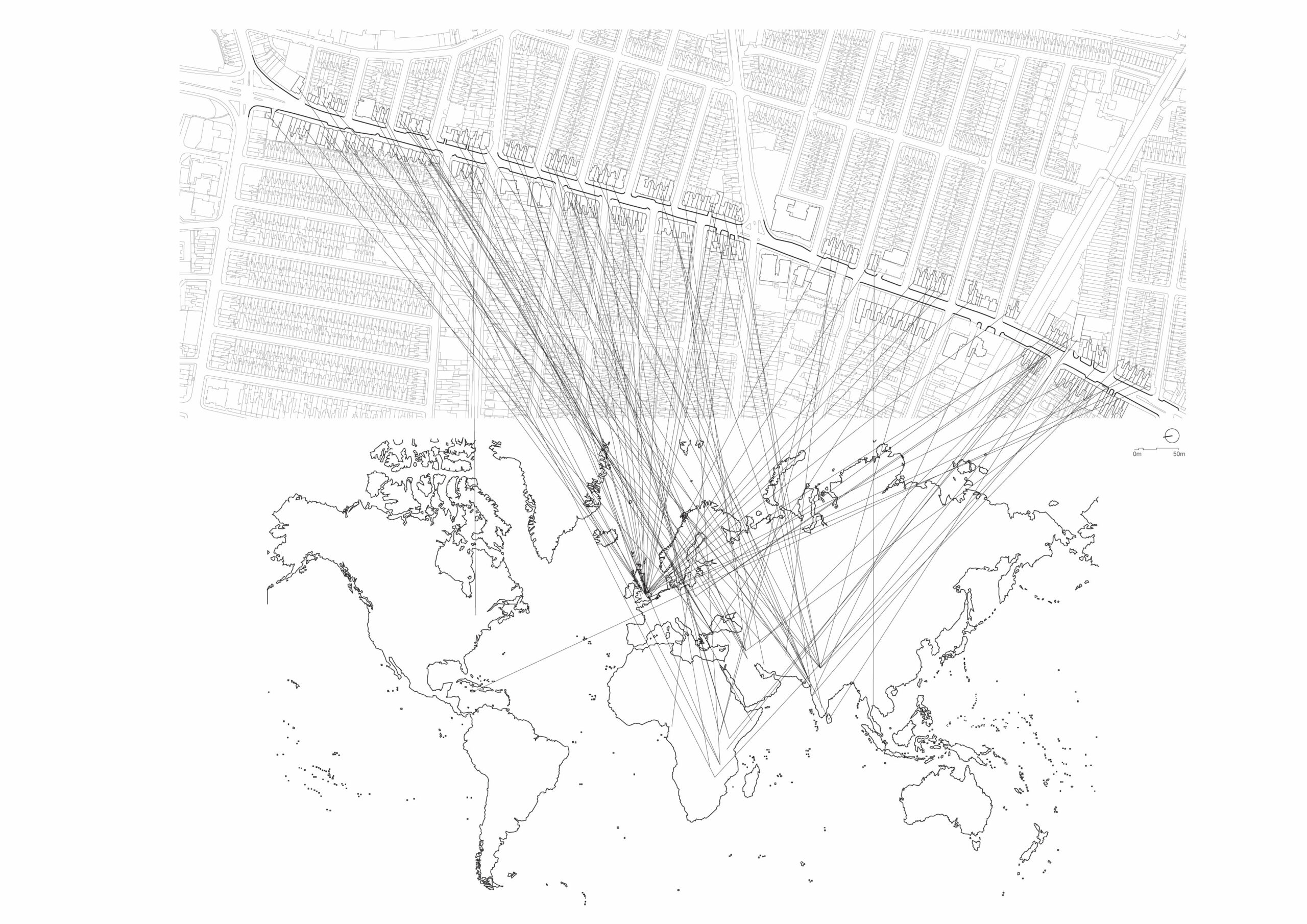
Join ACC as we host Suzanne Hall for a special academic seminar entitled The edge economies of migration on Tuesday, 25 February 2020 from 12:30 to 14:00 in the Davies Reading Room, Environmental and Geographical Sciences Building, Upper Campus, UCT. Camalita Naicker, of the Department of Historical Studies, University of Cape Town will act as a respondent. ABSTRACT ‘Edge Economies’ emerge in the asymmetries of global migration and the ongoing ferocities of urban marginalisation. From the grounded perspective of street economies formed in the peripheries of post-industrial UK cities, I explore the racialised frameworks of citizenship and economic inequality and their everyday contestations. I locate the global and urban formations of the edge in the European ideologies of displacement and immobility, incorporating the extended coloniality of political interventionism and human subordination. By moving between spaces of globe, state and street, I further explore the edge as a capricious space in which social sorting, cultural intermixtures and claims to difference are forged. Such combinations encourage connections between the histories and geographies of how people and places become bordered, together with practices of edge economies that are both marginal and transgressive. BIOGRAPHY Suzanne Hall is a Co-director of the Cities Programme and Associate Professor in Sociology at the LSE. Suzi’s research interests engage with the street life of brutal borders, migrant economies and urban multi-culture. WHEN: Tuesday, 25 February 2020 TIME: 12:30 - 14:00 VENUE: Davies Reading Room, Environmental and Geographical Sciences Building, Upper Campus, UCT  
Pairing academia and policy for transdisciplinary research in Africa

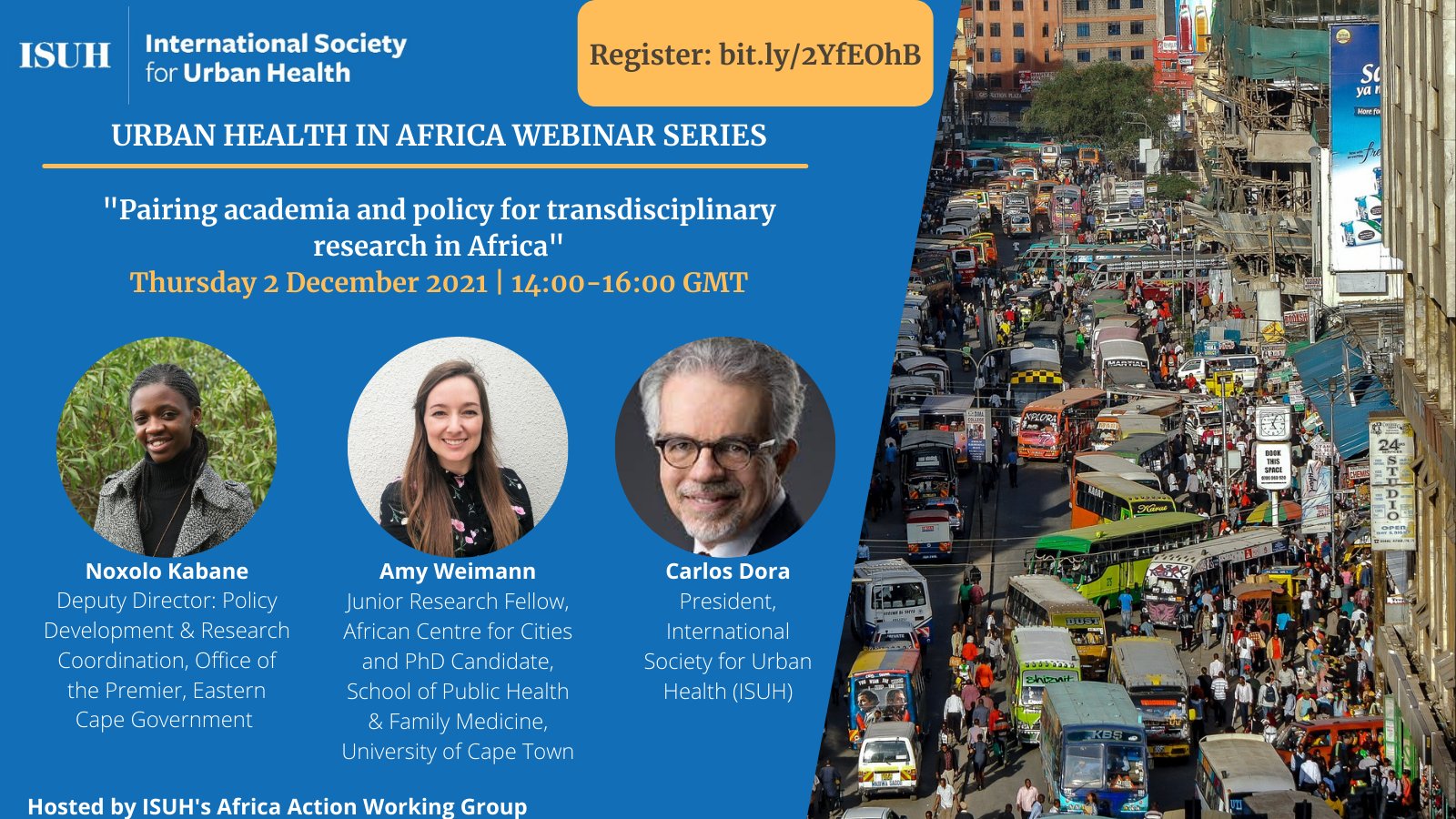
Join the International Society for Urban Health Africa Working Group for the first discussion in the Urban Health in Africa Webinar Series entitled Pairing academia and policy for transdisciplinary research in Africa.  SPEAKERS Noxolo Kabane - Deputy Director: Policy Development and Research Coordination, Office of the Premier, Eastern Cape Government Amy Weimann - Junior Research Fellow, African Centre for Cities and PhD Candidate, School of Public Health and Family Medicine, University of Cape Town Carlos Dora - President, International Society for Urban Health WHEN | Thursday, 2 December 2021 TIME | 14:00-16:00 GMT REGISTER HERE