CityLab Symposium

Studio 3 ENGEO Building, Upper Campus. University of Cape Town,, Cape Town, Western Cape, South Africa

The African Centre for Cities’ CityLab programme facilitates the co-production of policy-relevant knowledge to reduce urban poverty through the engagement of researchers, government officials and civil society. Started in 2008, the CityLab programme created a platform for interaction between practitioners and researchers and has generated a wide range of different kinds of knowledge on Cape Town. The CityLab programme also became a core component of Mistra Urban Futures, a network of institutions involved in the co-production of urban knowledge in five cities around the world. Please join us in reflecting on the Sustainable Human Settlements CityLab, the Urban Violence, Safety and Inclusion CityLab, the Healthy Cities CityLab and the Public Culture CityLab. The co-ordinators of the CityLabs, Dr Warren Smit, Dr Mercy Brown-Luthango, Dr Rike Sitas and Liza Cirolia, will present key findings from the CityLab process, followed by a discussion and a light lunch. The symposium will be hosted on 18 August in Studio 3 in the Environmental and Geographical Sciences building on Upper Campus at UCT, from 10h00 to 13h00, followed by lunch. Please RSVP to Rike Sitas on rike.sitas@uct.ac.za by 12 August 2016 CityLab_Symposium_Invite

‘A House for Dead People’: Memory and spatial transformation in Red Location, Port Elizabeth

Studio 3 ENGEO Building, Upper Campus. University of Cape Town,, Cape Town, Western Cape, South Africa

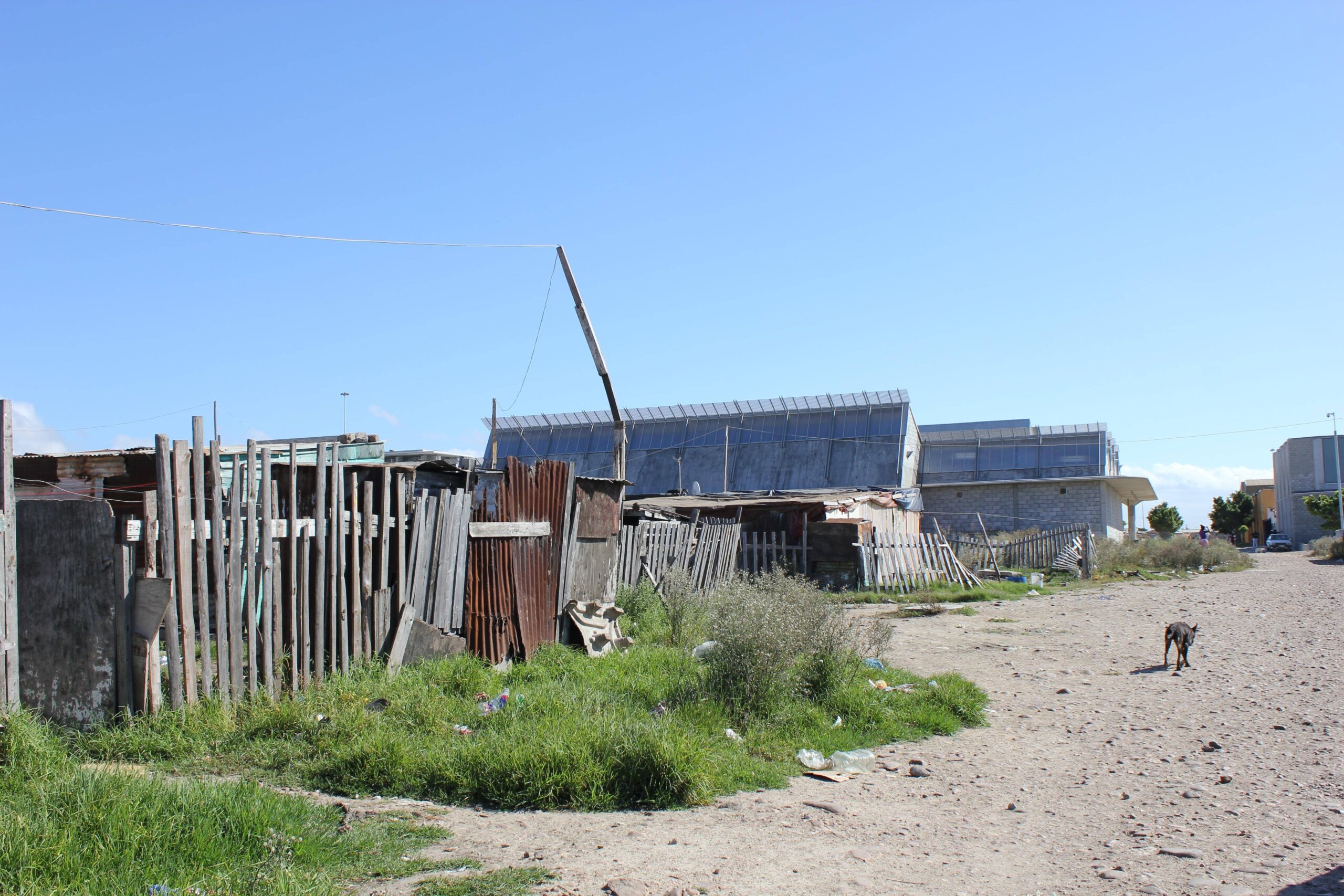
ACC is pleased to be hosting the 2016 Ray Pahl Fellow in Urban Studies, Dr Naomi Roux, who will be presenting a paper entitled, 'A House for Dead People: Memory and spatial transformation in Red Location, Port Elizabeth'. Abstract Following the end of apartheid in 1994, several new projects of public memory and urban development were established in many South African cities. In Port Elizabeth, the Red Location Museum was opened in 2006, in a century-old informal settlement with strong histories of resistance activity. The museum was intended to acknowledge the area’s contribution to the liberation struggle, and contribute to dismantling apartheid urban geographies by producing a tourist and cultural economy. However, the project was highly contested from its inception by residents who felt that the priority for the neighbourhood should be housing and service delivery. Major housing-related protests erupted on the museums doorstep between 2003 and 2005, and in late 2013 the new cultural precinct was closed down indefinitely. This paper examines the politics and controversies surrounding the Red Location developments between 1997-2013, using this case study to consider the ways in which the protests around the museum are deeply rooted in historical and political histories which are made visible through residents’ radical claiming of ownership of the museum building. Bio Naomi Roux is an urbanist and visual historian, with a particular interest in the relationships between collective memory, the politics of public space and urban transformation. She holds the Ray Pahl Fellowship in Urban Studies at the University of Cape Town’s African Centre for Cities for 2016. Prior to this she was the 2014-2015 Mellon Fellow in Cities and Humanities at LSE Cities. Her recent PhD (Birkbeck, 2015) focused on the politics of collective memory in the context of the changing post-apartheid city, using Nelson Mandela Bay in South Africa’s Eastern Cape as a case study. Previous work includes published research and exhibition projects focusing on heritage, memory and place-making in sites including Kliptown, Soweto; Yeoville, Johannesburg; and ‘Little Addis’ in central Johannesburg.

Food and transnational gastronomic culture amongst Cameroonian migrants in Cape Town and The Hague

Studio 3 ENGEO Building, Upper Campus. University of Cape Town,, Cape Town, Western Cape, South Africa

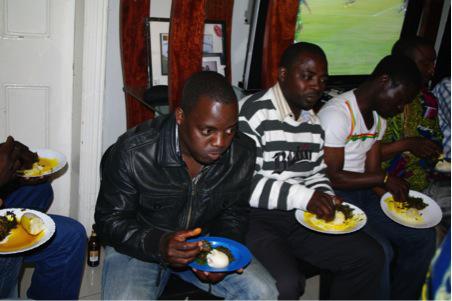
In this seminar, post-doctoral fellow at the African Centre for Cities, Dr Henrietta M Nyamnjoh will present a paper entitled, 'This Christmas I go ‘touch’ some fufu and eru”: Food and transnational gastronomic culture amongst Cameroonian migrants in Cape Town and The Hague'. Abstract Migrants’ relation to ethnic food and their experiences of migration are dynamic processes, experienced in a multiplicity of ways. This paper focuses on how mobility and migration are fast influencing the global food cultures and how increasingly foods are windows into the ways migrants live, think, and identify themselves. Foods are part of migrants’ cultural, historical and even emotional repertoires. Based on ethnographic research amongst Cameroonian migrants in Cape Town and The Netherlands, I explore how migrants travel with their gastronomic culture and/or improvise in the absence of ethnic foods. In the Netherlands, whilst migrants have found ‘home-away-from-home’ through the many shops that sell food from home they still manage to create transnational food chains/links when visiting home. While in Cape Town, despite these shops the absence of certain foods has prompted migrants to improvise and complement their foods, it has also given rise to specialised restaurants that provide Cameroonian cuisine. Through this ethnography I maintain that gastronomic culture can be thought of as a strong bond that affirms migrants’ Cameroonian-ness and keeps them attached to the home country. I question too the extent to which mobility and transnationality reconfigure food experiences amongst migrant communities and argue for multiple understandings of how migrants relate to food to the exclusion of their everyday experience. Bio Henrietta Nyamnjoh is a Post-Doctoral Research Fellow at African Centre for Cities and Environmental and Geographical Science, University of Cape Town. Her research focus is on migration, transnational studies, migrants and urban transformation and religion. She recently completed a study on the use of Information and Communication Technologies amongst Cameroonian migrants in South Africa, The Netherlands and Cameroon. The study (Bridging Mobilities: ICTs appropriation by Cameroonians in South Africa and The Netherlands) seeks to understand migrants’ appropriation of the new Information and Communication Technologies to link home and host country and the wider migrant community. She is also the author of “We Get Nothing from Fishing” Fishing for Boat Opportunities Amongst Senegalese Fisher Migrants (2010). She is currently working on transnational families and emotions amongst Cameroonians in Cape Town.

Overcoming water scarcity for good?

Studio 3 ENGEO Building, Upper Campus. University of Cape Town,, Cape Town, Western Cape, South Africa

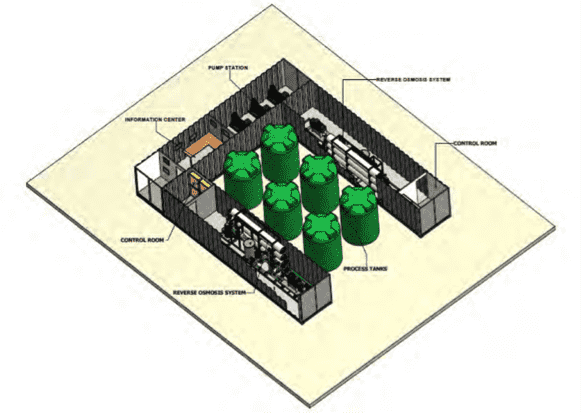
Dr Suraya Scheba is an ACC research fellow who will be sharing a paper entitled, 'Overcoming water scarcity for good: querying the adoption of desalination technology in the Knysna Local Municipality of South Africa'. Abstract In this paper I aim to query the Ecological Modernisation vision of green growth by focusing on the emblematic case of desalination technology as the solution to the threat of water scarcity. I focus the study on a drought crisis, which resulted in the adoption of desalination in the Eden District Municipality (EDM) of South Africa. Focusing on the towns of Sedgefield and Knysna, in the Knysna Local Municipality (KLM) of the EDM, I ask the questions of ‘what, how, by whom, why and to what end was desalination adopted?’. This interrogation is characterised by two movements, firstly tracing the emergence and form of the crisis - solution consensus; and secondly reading this against an examination of the historical material relations constituting both crisis and solution. The paper is informed by research that was carried out over a period of 11 months, from October 2011 to August 2012, during which I undertook 91 semi-structured interviews, extensive document analysis and participant observation. The twin analytical movement described above is undertaken in five parts. Firstly, I show that the dominant representation of 'drought crisis' insisted upon the indisputability of drought as a threat posed by an externalised nature. Next, in examining the historical materiality of drought I counter this narrative by showing the drought crisis to be a socio-natural assemblage, rather than an externalised threatening nature. This is a vital finding, showing that the support for the adoption of desalination technology as a necessary response to 'nature's crisis', pivoted on the maintenance of an ideological fiction. In the third part of the paper, moving on to an examination of the solution, it emerges that an essential element supporting desalination adoption was the employment of exceptional disaster and environmental legislation, enabling the urgent release of disaster funding to ensure water security for economic growth. This section also argues that the maintenance of the dominant crisis narrative served to produce a market opportunity for the desalination industry. In the remaining two parts of the paper I evaluate the 'promise' of the desalination techno-fix. Through focusing on the conditionality placed on disaster funding and its impact on project assembly, I argue that the mechanisms and logic through which the solution consensus emerged had a direct bearing on project assembly and consequent problems and costs emerging out of the desalination solution from the outset. In sum, the paper demonstrates that the adopted E.M. logic was a false promise that served to intensify the penetration of nature by capital, and resulted in a deeper movement into crisis by moving the problems around as opposed to resolving them. Bio Suraya completed her PhD in geography at the University of Manchester (UK). Her doctoral work examined the Ecological Modernisation vision of green growth by focusing on the emblematic case of desalination technology as the solution to the threat of water scarcity. The study was focused on a drought crisis, which resulted in the adoption of desalination in the Eden District Municipality (EDM) of South Africa, focusing specifically on the towns of Sedgefield and Knysna, in the Knysna Local Municipality (KLM) of the EDM. Since May 2015 she works as a post-doctoral research fellow at the African Centre for Cities (ACC) at the University of the Cape Town. In this capacity, she forms part of a research team concerned with exploring theories and practices of emancipatory change. At one level, her focus is on leading an in-depth study on Informality, urban poverty and inequality in the low-income community of Delft, Cape Town. This study forms part of a larger multi-sited research project, positioned within a collaborative initiative between a handful of South African Research Chairs working on strategies to overcome poverty and inequality. At another level she will participate in workshops and discussions, drawing on both grounded findings and theoretical debates, to build empirically-informed theory and policy related to questions of transformative change.


Radical Incrementalism & Theories/Practices of Emancipatory Change

Studio 3 ENGEO Building, Upper Campus. University of Cape Town,, Cape Town, Western Cape, South Africa

This workshop examines ideas of radical incrementalism across our towns and cities. It seeks to explore theories and practices that can support emancipatory change across urban regions through the power of urban dwellers to challenge poverty, oppression and unjust environments.

A Brief Symposium on Accessing Land in African Cities

Studio 3 ENGEO Building, Upper Campus. University of Cape Town,, Cape Town, Western Cape, South Africa

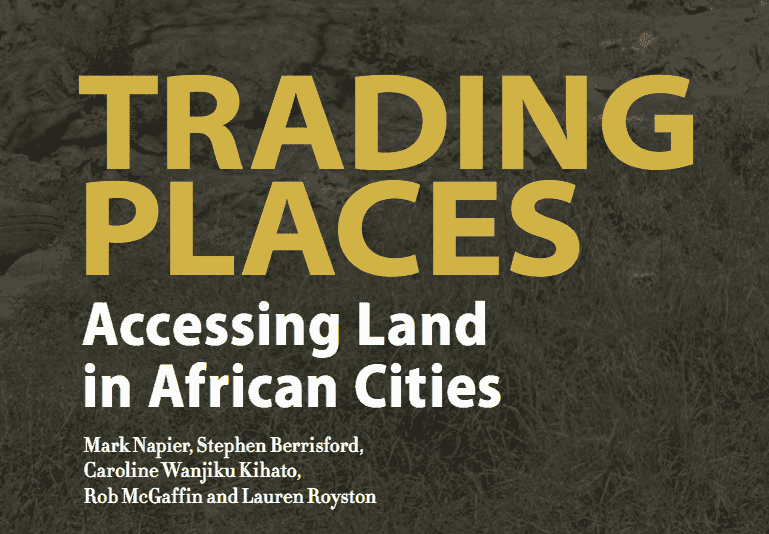
A recently released book called "Trading Places" is about how urban land markets work in African cities. The book explores how local practice, land governance and markets interact to shape the ways that people at society's margins access land to build their livelihoods.